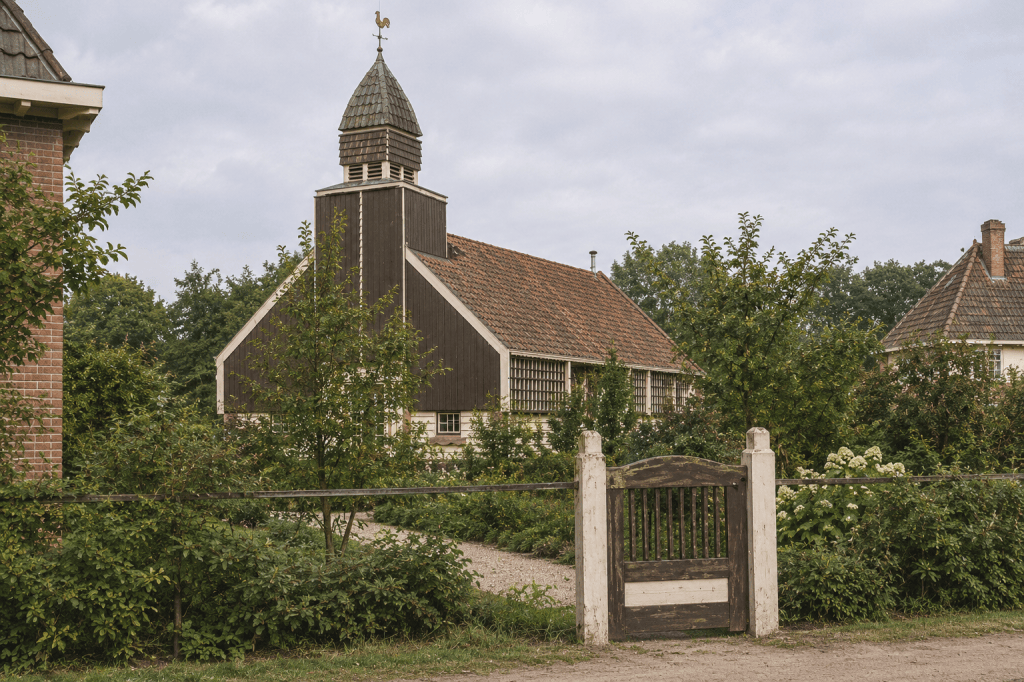
AI-generated colour reconstruction of the Hervormde Jeugdkapel (Kinderkerk), Meentweg 54, Bussum, based on archival photographs. The colours are interpretive.
To give the unfinished pull of Venda another direction, a son searches his parents’ past in the Dutch resistance.
For my children, grandchildren and great-great-grandchildren, and for all generations seeking a better world.
Paul Alexander Wolf
Prologue: Why I Am Writing This
Why am I writing this?
I have asked myself that question more than once. The simplest answer is that this story is part of my history. But that is not the whole truth.
In 2026, Betty and I went back to Venda, more than thirty-five years after we had left. We returned to the small clinic at Tshilwavhusiku, where I had worked as a young doctor, and to Siloam Hospital. In one week, much came back: physically, emotionally, spiritually. I had told myself it would be a visit, a way of closing a circle. Perhaps I hoped that going back would quiet something in me.
It did the opposite.
At Tshilwavhusiku, we stood beside the house prepared for us more than thirty-five years earlier. We had planned to make our life there. I was to become the clinic’s first permanent doctor, serving two other clinics as well. We were only weeks from moving when life took us elsewhere. The house found another purpose. The acacia tree was still standing.
That future never began.
Siloam was different. There, our work and relationships had already taken root. But the situation at the hospital was growing increasingly difficult, and private family circumstances left us with no real choice. On the advice of the acting superintendent, Dr Gert Maritz, we returned to the Netherlands. There was little time to prepare and little chance to say goodbye. What had been built over time seemed to come apart in weeks. Life moved on.
When we returned this year, we heard from people who had worked at Siloam, from patients and from relatives of patients. They described lasting effects of the hospital’s abrupt changes. Some told us that the care they later encountered felt different in nature. I cannot assess or compare that care. I can only report what people told us, and how deeply their accounts moved us. What seemed to us a rapid departure had not simply ended when we left.
For more than thirty years, as I worked across different countries and continents, I had quieted a whisper: that I had left something unfinished in Venda. Going back did not quiet it. It brought it back.
I know how that sounds. Unfinished business. A useless idea and emotion, perhaps, neither practical nor realistic. But then, so was my choice to study medicine, all those years ago, against the odds. Some of the most important choices in my life have made no sense on paper.
I have come to think of these things as energies: the responsibilities we take on, those circumstances place upon us, and the burdens we must sometimes choose not to carry. Going back to places that never left you stirs them up. You find that life has moved on, as it should. And yet the pull remains, against all reason. We cannot know in advance what our choices will mean. Often we understand them only in hindsight. Even when events narrow our freedom, some room may remain in how we respond.
I am seventy-one as I write this. Getting older does not make major transitions easier, not for me and not for my family in Australia and South Africa. And still, Venda opened an inconvenient truth in me: I cannot retire in peace simply by keeping the status quo, doing my courses and locum work in Australia, as if nothing had been stirred.
I tell myself I will resist if a door opens. I am not sure I believe it.
So this story is, in part, a rebalancing act. An attempt to give that restless energy another direction by travelling back, not to Venda this time, but into my own family’s past. Perhaps it is an antidote. Perhaps it is a way of making peace with what we hoped might happen but never did.
Unless we record our stories, they may disappear with us. Many go untold because lives are cut short or changed by war, oppression, illness, or events no one could foresee.
That wish to preserve lives and names is also why I have written about Dr Evert and Dr Leida Helms, whose long service shaped Siloam, and Dr Pierre Henri Jaques, whose leadership shaped Elim. The story of a hospital is never only the story of its doctors. Professor Koos van Rooy, whose work included the Venda Bible translation, belonged to Siloam’s wider story. So did Mary, the pastoral worker; Maartje Kruger in the laboratory; and Philip and Christa, who helped keep the hospital running. I have named them, but I have not told their whole stories. Even a name in print cannot stand in for a life.
This account tells a small story: one family’s search into a corner of the Second World War. What happened to us in Venda and what happened in Bussum are not equal in scale or consequence. What connects them here is the question of what remains with us, and what we choose to remember. A story need not change the world to matter to the people who lived it, or to those who come after them.
Remembering also asks us to be fair. People who acted against humanity must be described truthfully; their families are not responsible for those actions. Public judgement can be unforgiving, and sometimes it falls on people for the wrong reasons. To remember well, we must be honest about wrongdoing and careful about where we place blame.
My father’s war ended in 1945. Its effects did not. He survived, built a new life and worked faithfully for decades. Yet I wonder whether he ever fully came home from one evening in 1943. Perhaps he, too, kept returning in memory to a place that had never left him: a street corner in Bussum.
I did not understand that when I was young. I think I am beginning to understand it now. Going back to Venda has helped me see why I am now going back, through records and memory, to my parents’ past.
This is my father’s story, and my mother’s. But it is also, I realise, a little bit mine.
A note about memory: This account brings together records, my memories of what my parents told me, and scenes I have had to reconstruct. These are different kinds of evidence. I cannot know whether either of my parents told me everything, what they chose to keep private, or how much I misunderstood or forgot. I try to distinguish what the records say, what I remember them telling me, and what I can only imagine.
Chapter One: The Corner
My dad never told this story at the dinner table. It came to us in fragments, the way war stories often reach children: a sentence on a walk in the forest near Haamstede, a silence when certain names came up, a look that ended a question before it was asked.
Only now, more than eighty years later, am I putting the pieces together. Some I hold in my hands as documents. Others come from memory or can only be pictured.
This is where it begins: Bussum, 9 September 1943.
A small youth chapel stood on the Meentweg, next to the minister’s house. By 1943, the chapel had become a meeting place for a group of young men and women who called themselves De Vliegende Brigade, the Flying Brigade. Most were students. They gathered intelligence on German defences, smuggled weapons and helped people in hiding. That autumn they were drawn into preparations for a planned liquidation. In my dad’s account, the intended target was a German officer he believed responsible for deporting Jews.
One of them was a law student, Louis Gustaaf Wolf, known as Wiet. He was my dad. Another was a young woman, Ida Haan, who carried messages between resistance groups. She would become my mum.
As I remember my dad telling it, he felt uneasy that evening. Something in the way the plan was being discussed did not sit right with him. The meeting was paused. He went to look for a comrade who should have been there but had not come. At that house he saw police cars waiting under the trees.
I picture him walking back along the Meentweg, faster now, trying not to look as if he was hurrying. I do not know what he was thinking. Perhaps he was counting the faces he had left behind in the chapel. Perhaps he was telling himself it was nothing.
At the corner of the street, a young woman stopped him. It was my mum.
I have tried many times to imagine that moment. Two people in their early twenties, on an ordinary street in an occupied country, sensing that something had gone wrong. I cannot know what either of them understood then, or what they said to each other. I imagine neither knew they would one day marry.
Dad still tried to reach the chapel. In the back yard, the minister’s wife blocked his way. The Germans had already taken the building, she told him. “Get out of it!”
He got out of it.
Inside, his friends were being arrested. Among them were Joop Kemper and Herman Ruys, both twenty years old. Six weeks later, seven men would be shot in the dunes near Overveen.
The post-war records tell the story more briefly than Dad did. They say L.G. Wolf and I. Haan escaped because, suspicious as they were, they had left the chapel early, probably after the SD car had been seen nearby. One sentence. Two lives spared. And because of it, a family that would one day include me.
I have read that sentence perhaps fifty times. It does not say what it cost Dad to walk away. It does not say how often, in the years that followed, he went back to that corner in his mind. It does not say that a person can survive a war and never fully come home from it.
“Suspicious as they were.” I think that is the truest thing anyone wrote about my mum and dad. They sensed that something was wrong, and it helped save their lives. But I wonder whether Dad ever forgave himself for being right while the others were not.
There is a question no archive can answer. Why do some people hear the warning and others do not? Why does one person stop at the corner, and another walk through the door?
I do not believe my mum and dad were braver than their friends. They were young people who had made a choice, and on that evening the choice nearly destroyed them. War did not ask their permission. It happened to them, and to people everywhere whose lives are caught up in events larger than themselves.
And then life asked them to choose again: walk away or go back in; stay silent or speak; hate or try to understand.
My dad chose to survive that night. What he chose afterwards is the rest of this story.
Chapter Two: The Young Ones
They were not soldiers. That is the first thing to understand.
The Vliegende Brigade was founded in October 1942. Several of its members lived in Het Spiegel, the leafy villa district of Bussum. Joop Kemper, an economics student, was one of its founders. The Germans had arrested him once before, in 1941, and let him go.
Herman Ruys was his friend, a notary’s son. Mart Raben, born in Palembang in the Dutch East Indies, worked on the group’s intelligence. He made drawings of German defences at IJmuiden, along the coast of Walcheren, at Venlo airfield and at the Palmkazerne in Bussum. Willy van Breukelen and Johan Schimmel were also among the young men of the group. Antonius Tellegen, older than most of them, carried reports and drawings to the Ordedienst in Amsterdam.
And there was my dad, the law student, and my mum, the courier.
I find it hard to picture them as they must have been then. I knew my dad as a man who walked the forests of Zeeland and played the organ in old churches. I knew my mum as a woman who later became a social worker. But in 1943 they were young people carrying messages, drawings and secrets on bicycles through an occupied country, knowing that one wrong stop could mean a cell, a camp or a firing squad.
In some records the group appears under a name that stopped me when I first read it: “verzetsgroep Wolf,” the Wolf resistance group. Other accounts name Joop Kemper as its founder and leader. My dad was, as far as I understand it, one of its leaders. I may never know exactly how the group was led. Perhaps leadership in such groups was less tidy than the files suggest. Perhaps each of them led in their own way.
What the records make clear is that they worked with the Ordedienst and with the remains of CS-6, an Amsterdam resistance group already broken by arrests. On 19 July 1943 they took part in a raid on the distribution office in Huizen to obtain ration cards. They supplied the weapon for an attack on Bussum’s NSB police chief, E.J. Woerts. And they began to plan further violent action.
As my dad explained it to us, their first purpose was to protect people the occupiers were hunting, above all Jewish families who faced deportation to the camps, or death if they were found. Hiding them, feeding them, finding papers and ration cards: that was where it began. But week after week the transports kept leaving, and people were still being taken. Food and shelter were no longer enough. So they turned to resisting the occupiers directly.
My dad’s parents, meanwhile, were sheltering Jewish people in their home at the Parklaan. The whole family was living a double life.
I sometimes ask myself why they did it. There was no army to join, no uniform, no glory. If they were caught, there would be no prisoner-of-war camp. There could be a sham trial and a firing squad, if they were lucky enough to get a trial at all.
I think the answer may be simpler than courage. They looked at what was happening to their Jewish neighbours, to their country, to their friends, and decided they could not live with themselves if they did nothing. It was a choice. Not a heroic one, perhaps, at first. Just a refusal to look away.
The trouble with such choices is that, once made, they cannot be unmade. And they draw in other people: parents, friends, a minister’s wife, a policeman driving a car. Every one of them would soon have a choice of their own.
Chapter Three: Who Talked?
The records offer several threads about how information reached the Germans. I cannot be sure that they form one complete chain.
One thread begins in a café. A professional soldier who lived in Bussum had a drink, then another, and talked too much. What he said had come, in the end, from Herman Ruys. A man from Hilversum heard it, and the information went where it should never have gone.
Another thread begins in a car. Johan Schimmel had been arrested and was being driven to Amsterdam by Naarden policemen. One of them, a constable named Alle Jongbloed, did something extraordinary. At Schimmel’s request, he threw incriminating papers out of the car window. A small act. A policeman’s quiet choice. It would cost him his life.
Schimmel ended up in the prison at Scheveningen. There, the Germans placed a man in his cell. Schimmel trusted him and talked about how the resistance in Bussum was organised and what it had done. The man was a provocateur.
A further thread leads to the table in the chapel. Someone had offered to help with the planned liquidation. He seemed useful, someone with access. My dad later told us he had never trusted the man and believed the Germans had planted him in the group. The records support the core of that account: a provocateur posed as someone who could help with a planned liquidation, and the meeting was betrayed.
Somewhere along the way, the Germans also found a note on one of the arrested men, a list of names. Herman’s name was on it. So was his brother Hugo’s.
When I first read these threads, I wanted a villain. Someone to blame. A name in capital letters.
But the longer I look, the less simple it becomes. A soldier with loose lips after a drink. A frightened young prisoner who wanted to believe he had found a friend. A note that should have been burned. People can be caught by tiredness, loneliness, fear, or one glass too many.
The men who gathered these threads together were not confused about what they were doing. They were two officers of the Sicherheitsdienst in Amsterdam, Friedrich Christian Viebahn and Emil Rühl. They led the raid on the chapel on 9 September 1943.
That evening Herman’s younger brother Hugo heard what had happened. He ran to the minister’s house next to the chapel, the same house where Dad had been warned away. Hugo was arrested there too. He was released three weeks later.
The next day the Germans arrested Jongbloed, the policeman who had thrown the papers out of the car. At the end of September they took Rein de Vries, a police detective in Bussum who had helped the group.
So the net closed. Not with one betrayal, but with several threads of information and a deliberate trap.
I still do not know the name of the man in Schimmel’s cell. I do not know the name of the man at the chapel table. My dad may have learned them. If he did, he never told me.
Chapter Four: The Dunes
Six weeks. That is how long it took.
On 22 October 1943 a German police court in Amsterdam sentenced seven men to death: Joop Kemper, Herman Ruys, Mart Raben, Johan Schimmel, Willy van Breukelen, Antonius Tellegen and Abraham Kornelis Kuiper. Kuiper was connected to the CS-6 resistance network with which the Brigade had worked. Karel Raben, Mart’s brother, was also initially sentenced to death but was reprieved.
The next day, 23 October, the seven men were taken to the dunes near Overveen, west of Haarlem. They were shot and buried in a mass grave in the sand.
Earlier that month, the Germans had shot nineteen members of CS-6 in the same dunes. Among them was Louis Boissevain, whom the Brigade had supplied with a weapon.
I have walked in dunes like those. They are beautiful: sand, marram grass, wind, the sound of the sea somewhere beyond. It is hard to believe what happened there. Perhaps that is the point of beautiful places. They do not remember. We have to do the remembering for them.
After the war the bodies were found and reburied at the Eerebegraafplaats, the cemetery of honour, in Bloemendaal. In 1948 Bussum named streets after some of the resistance fighters in a new part of town. Children now cycle to school along Ruysstraat and Kemperstraat. Most of them, I imagine, have no idea why.
For the Ruys family, the war was not finished. Hugo, the brother who had been released, went back to the resistance. He helped publish an illegal news bulletin of Het Parool. In January 1945 German soldiers stopped him for riding his bicycle without a light. In his bags they found copies of the paper. On 7 March, two months before liberation, he was shot with fourteen other men on the Haarlemse Dreef in a reprisal whose precise trigger remains uncertain.
His father Gerrit, the notary, had helped Jewish families protect their property. He was arrested and died during a transport in April 1945, after being imprisoned at Neuengamme.
His mother Hannie was released. After the war she learned that her husband and both of her younger sons were dead.
Rein de Vries, the Bussum detective, died in Neuengamme in February 1945. Jongbloed, the Naarden policeman who threw the papers out of the car, died there too. Others from the group came back from Dachau and Neuengamme, alive but changed.
And my dad? After the escape he could not go home. He was a target, and he knew it. He found shelter in the household of my mum’s parents, the people who would later become my grandparents on her side.
So the two who had escaped the chapel raid ended up under one roof, in hiding, with fear at the door and grief for their friends inside. I have thought about what that must have been like: the knock that might come at any hour, the faces of the dead, the closeness of two young people who had survived what the others had not. Whatever grew between them, it grew there.
Somehow, in those years, Dad also continued his law studies. I understand that Professor Ko (Jacobus) Oranje of the Vrije Universiteit allowed him to do so while he was in hiding with Mum’s parents. The university had closed, but clandestine teaching and examinations continued. Regular trips to Amsterdam for lectures seem unlikely; I do not know what arrangement was made for Dad.
I have often wondered how he managed to study law while his friends lay in the dunes and the people who put them there were still looking for him. Perhaps the law was the only thing that still made sense. Perhaps he already knew what he would do with it.
Chapter Five: Across the Table
In June 1945 the war in the Netherlands was over. In a prison cell in Amsterdam sat Emil Rühl, the SD officer who had helped lead the raid on the chapel.
Rühl did something unexpected. He asked the Canadian police to let him speak to the Dutch authorities. He wrote that he could give information about cases handled by the Sicherheitsdienst, including cases in which the names of Dutch informers appeared. He could help solve murders.
The hunter was offering to hunt again, this time on the other side, to save himself.
His statements led to the questioning of others: senior SD officers, Dutch collaborators, and his own partner, Viebahn.
And at some point in those years after the war, my dad sat across a table from three German SD men. The record names them as Emil Rühl, Friedrich Vierman and Hans Fiebahn. Whether Fiebahn was Viebahn, who led the chapel raid, I cannot yet say.
The records say that L.G. Wolf questioned them to establish who had betrayed the group. The local history of the Naarden police in wartime says the interview reports were not preserved. I do not know what was said in that room. I do not know whether Dad shouted or stayed calm, whether the men looked him in the eye, or whether he learned what he had come to find out. I can only imagine.
I picture two chairs and a table. A window, perhaps. A typist in the corner. On one side, a young Dutch lawyer who had last seen his friends alive in a chapel on the Meentweg. On the other, a German policeman who had come to arrest them. Two years earlier, Dad would have been the one in the chair with no power. Now the chairs had turned.
What I remember my dad telling us is that he did not do it for revenge. He wanted to understand how ordinary men become instruments of evil. That question stayed with him all his life. I think it is the question at the heart of this story.
These were men with families and ordinary beginnings. Viebahn had been a policeman before the war. Yet he and Rühl took part in arrests, beatings and killings. Viebahn was involved in reprisal killings known as Silbertanne and in the arrest of resistance leader Johannes Post. Rühl transported Hannie Schaft to a prison in Amsterdam. She was later taken to the dunes near Overveen and executed, weeks before liberation.
In October 1949 a Dutch special court sentenced both men to fifteen years in prison. The prosecutor had asked for the death penalty. On appeal, Rühl’s sentence rose to eighteen years; Viebahn’s also ended at eighteen.
Then the war began to fade, and with it the appetite for punishment. Viebahn was pardoned in 1956, and Rühl probably was too. Both were released early and handed over to West Germany. After that, they largely disappear from the record. I do not know what happened to them later.
Seven young men in a mass grave in the dunes. Two SD officers released after serving part of their sentences.
I do not know how my dad felt when he heard. I can guess.
Chapter Six: The War After the War
My dad did not stay in law for long. After a brief time in a law firm he became an inspector of education, first in Goes, then Apeldoorn, then Arnhem. He had no training in education. I have always thought there was something meaningful in that choice. A man who had seen what people do to one another chose to spend his life looking after schools.
I was born in Goes. My earliest memories are of Saint Nicholas arriving by boat in the harbour, and of summers in Haamstede, near the lighthouse. Dad took me on long walks in the forest and told me about everything we passed: old churches, historic towns, the history hidden in ordinary places. He played the organ in some of those churches. He loved what had endured.
But there was always something he did not talk about. The war sat in the house like an extra person at the table. I knew it was there, but no one introduced it.
Both my grandfathers died before I was born. The two households I came from were very different, and the war left marks on both that went beyond what I was told. After the war my mum carried something towards her own mother that she never fully explained to me. Later in life I heard stories I chose not to pursue, because they did not fit the picture I had.
I have learned that people in hiding, isolation, loneliness or despair sometimes do things they would never do in ordinary life. Some things may be better left where they are. I try to accept life as it was, without judgment. But I also hold on to the picture I needed as a boy, after a childhood that was not always easy or straightforward. Perhaps both are a kind of loyalty.
I believe my dad was permanently marked by the war and the loss of his friends. Like many who had lived through it, he never fully adjusted to peace. The marriage that had begun at a street corner, and grown in a house of hiding, could not survive the quiet years. Some twenty-six years after the war, my mum and dad divorced. My brothers and I were caught in the middle.
There is something I only understood much later. As a boy in Apeldoorn, I had a headmaster who hit children, with his hands and sometimes with his feet. In secondary school I took a firm stand against corporal punishment. When a teacher hit one of us, I led the whole class out of the room. I was punished for it again and again.
I did not know then that I was doing a small version of what my dad had done. I had no idea about the chapel, the corner or the dunes. I only knew that you do not stand by when someone is being hurt.
Maybe that is how it works. Trauma may pass down through families, but so can conscience. Children inherit not only their parents’ wounds, but also their refusals.
In 1989 a local historian researching the wartime police of Naarden came to speak with my dad. He was willing to talk. But when the historian asked about Jongbloed, the constable who threw the papers out of the car and died in a German camp, Dad could not remember him, although the name came up several times.
I think about that often. A man who risked and lost his life for the group, and the survivor could not recall him. I do not read it as indifference. I read it as one of the things war may do to memory. Some things stay sharp for a lifetime. Others are buried so deep they do not come back.
I also remember my dad saying that he had spoken with the historian Loe de Jong, who wrote the major history of the Netherlands during the war. As I remember it, Dad was not impressed. He felt De Jong had not taken the time to really listen. Perhaps that is another reason Dad stopped telling the story. When you finally speak, and no one really listens, silence can feel safer.
Chapter Seven: The Archive
I am a doctor. I have worked in the Netherlands, in England and Scotland, in Australia, and at Siloam Hospital in Venda, South Africa. I have followed a colleague’s work in Gaza from far away, with fear for her safety and for the people she was trying to help.
Wherever I have worked, I have seen how violence and upheaval enter ordinary lives: a mother walking for hours with a sick child, a nurse improvising with little, a young doctor deciding whether to stay or go. People are forced into choices they never wanted to make.
Going back to Venda taught me how places can call us back long after we have left them. Perhaps my dad went back to that corner on the Meentweg in memory for the rest of his life. And now I am going back there too, through the records.
The Dutch state kept files on people investigated for collaboration after the war. I have been trying to piece together what the records and local histories can tell me. Somewhere in that material may be the man in Schimmel’s cell, the man at the chapel table, and the soldier in the café. There may be Rühl’s own statements, and perhaps a record of my dad’s questions, written down by a typist in the dry language of an official report.
I have decided not to write to the CABR. Some questions may remain unanswered.
I do not know whether I will ever find the name of the person who betrayed my parents’ friends. And if I do, what then?
There are things in life you would rather not know. There are others you cannot rest until you do. Whether the name of a long-dead informer can change anything, I do not know. The seven men will still lie in Bloemendaal. My dad will still have carried what he carried.
But I think he would understand why I have looked. He sat across that table for the same reason. Not revenge. Understanding. How do ordinary people become instruments of evil? And how do other ordinary people find the strength to refuse?
Chapter Eight: The Lighthouse
When I think of my childhood, I think of the lighthouse at Haamstede.
It stands at the edge of the dunes on the island of Schouwen. As a boy I watched it from our holiday house, turning its light through the summer nights. Lighthouses do not move. They do not run from storms. They give light, not because the sea is calm, but precisely because it is not.
I think my dad was a little like that lighthouse, and also not. He stood firm when it mattered most: at the corner, at the chapel, at the interrogation table. But the storm stayed inside him for the rest of his life.
The German occupation in Bussum was one history. What we encountered at Siloam decades later was another: political unrest and a hospital under strain, not war in the same sense. Gaza today is another reality again. I do not equate them. I recognise that, in very different circumstances, larger forces can enter ordinary lives and leave people carrying their effects long afterwards.
When those forces arrive, life may still ask us to choose, though it may already have taken much of our freedom away.
A soldier in a café talks too freely. A frightened prisoner trusts someone who is not his friend. A policeman chooses to throw papers out of a car window. A minister’s wife chooses to block a young man’s way. A young woman stops him at a corner. A family chooses to open its door to a hunted man. A German officer names others to save himself. A court passes sentence. A young lawyer chooses to understand rather than to hate.
And a son, eighty years later, chooses to know, while also choosing what to leave in peace.
I think of the words attributed to Willem van Oranje after he was shot in Delft: “My God, have mercy on my soul … My God, have mercy on this poor people.” The words were recorded soon after his assassination, though later forensic findings cast doubt on whether he could have spoken after being so badly wounded. I do not take the plea for mercy as an acquittal of the assassin. It leaves me with a harder question: can we seek justice for what people have done and still hope for mercy for their souls?
Some people may not understand the full reach of the harm they cause. Others know enough to be responsible for their choices. Neither truth makes the harm disappear. I cannot forgive on behalf of those who were harmed. But I can hope that mercy is possible, even for the dead.
Most of the people in this story are gone. The former chapel on the Meentweg became a community centre in 1973 and is now a private residence. The people who live there today may know little of what happened within its walls in September 1943. Life moves on. Some of the larger trees may still stand nearby, quietly carrying their witness in the leaves. The dunes are quiet. The lighthouse still turns.
I do not know how this story ends. Perhaps it does not end. Perhaps it simply passes on, like a light handed from one generation to the next, to anyone willing to carry it.
My dad chose to survive that night in September 1943. My mum stopped him at the corner. Her parents took him in. Because of them, I am here to tell it.
The question they leave me is not whether anyone can choose freely in a war. Few can. It is this: when war has taken so much choice away, what can we still choose for one another?
Epilogue: Home, and Leaving Again
As we left Venda to return to Australia, I realised that for a brief time I had felt at home there again, and then, once more, had to leave.
The return hit me harder than I expected. It was as if life had been drawn out of me. For weeks I walked with difficulty, carrying an immense tiredness that lifted only slowly.
Soon after, I sat a resuscitation exam: life support practised on mannequins, with examiners waiting to hear every step spoken aloud. It felt artificial. Yet it reminded me of something true: life can change in a split second, and what matters is recognising the picture and acting at once. Perhaps that exam, artificial as it felt, helped me begin to recover from the shock of having been home so briefly.
I began to wonder whether leaving Venda in 1990 had set me travelling across the world as a doctor ever since. I do not know. But Betty and I had found the courage to return, whatever the visit brought back with it.
My parents left the chapel early because danger had gathered around them. Betty and I left Venda suddenly, before we were ready, for reasons of our own. These were very different departures. But the title speaks to both: leaving before a story feels finished, and returning years later as changed people. We did not return to resume the life we had left. We returned to meet the place, and ourselves, as we had become, with our commitments to each other and our family still shaping the choices before us.
I suspect many people have such places. Some return. Others leave them behind on purpose, as something unresolved, not to be revisited. Even people whose lives look successful carry places they embrace and places they avoid. We cannot always decide what life places before us. But we may still have some choice in how we respond: whether to let go, or to explore again.
I think my retirement will look different from my father’s. From what I could see, he continued to struggle with relationships and with the effects of war. My mother had her own struggles, some of which I have chosen not to pursue. Their life together began under circumstances shaped by war; the decision to marry was theirs. The war affected them both, but it cannot by itself explain their marriage or its end.
My father was gifted, and I never felt he reached his full potential. He worried a great deal about his health. For me, the best of him lives in two places: his wartime story, and the years of my early childhood.
I have chosen to explore. I do not yet know where it will lead. But I would rather walk towards the places that call me than spend my remaining years wondering what they might have said.
Selected Sources and Notes
These references support the historical context of this account. My own recollections and reconstructed scenes are memoir, not archival fact.
- Vrije Universiteit Amsterdam, Geheugen van de VU, “De Vrije Universiteit in oorlogstijd”, on the university’s closure, clandestine study and examinations, and Professor Jacobus (Ko) Oranje’s wartime role.
- Vrije Universiteit Amsterdam, Geheugen van de VU, “VU-voorwerpen en hun verhalen: 1940–1945 — De oorlogsplaquette”, on Oranje and clandestine teaching and examinations at professors’ homes.
- Vrije Universiteit Amsterdam, “History”, for the university’s wartime closure.
- Parlement.com, “Prof. Mr. J. (Ko) Oranje”, for biographical details and his VU appointments.
- Historische Kring Bussum, “Jeugdkapel (Hervormd), Meentweg 54”, on the chapel’s design, 1921 opening, 1973 conversion to a community centre and later use as a home. See also tgooi.info’s building history.
- Archief Gooi en Vechtstreek, image catalogue, for the archival photographs used as references for the colour reconstruction. The individual catalogue numbers or record links for the two photographs should be added when available.
- Eerebegraafplaats Bloemendaal, profiles of Martinus Raben, Herman Ruys, Johan Schimmel, Willy van Breukelen, Antonius Otto Hermanus Tellegen and Abraham Kornelis Kuiper.
- Historische Kring Bussum, profiles of Johan L. Kemper, Herman Ruys, Hugo F. Ruys and Gerrit Ruys.
- “Gemeentepolitie Naarden in oorlogstijd”, section “Alle Jongbloed,” on the inquiry, the 1989 interview with L.G. Wolf and the unavailable post-war interview reports.
- Nationaal Archief, inventory 2.21.281.40, listing dossiers concerning the prosecution of Viebahn and Rühl.
- Nationaal Archief, “Moord op Willem van Oranje (1584)”, for the words attributed to him; NPO Kennis discusses why the famous last words are disputed.
- Paul Alexander Wolf, “My Dad During the 2nd World War” and “About Paul Alexander Wolf – ‘Continuer à essayer’”. These are earlier personal accounts and recollections, not independent corroboration.

