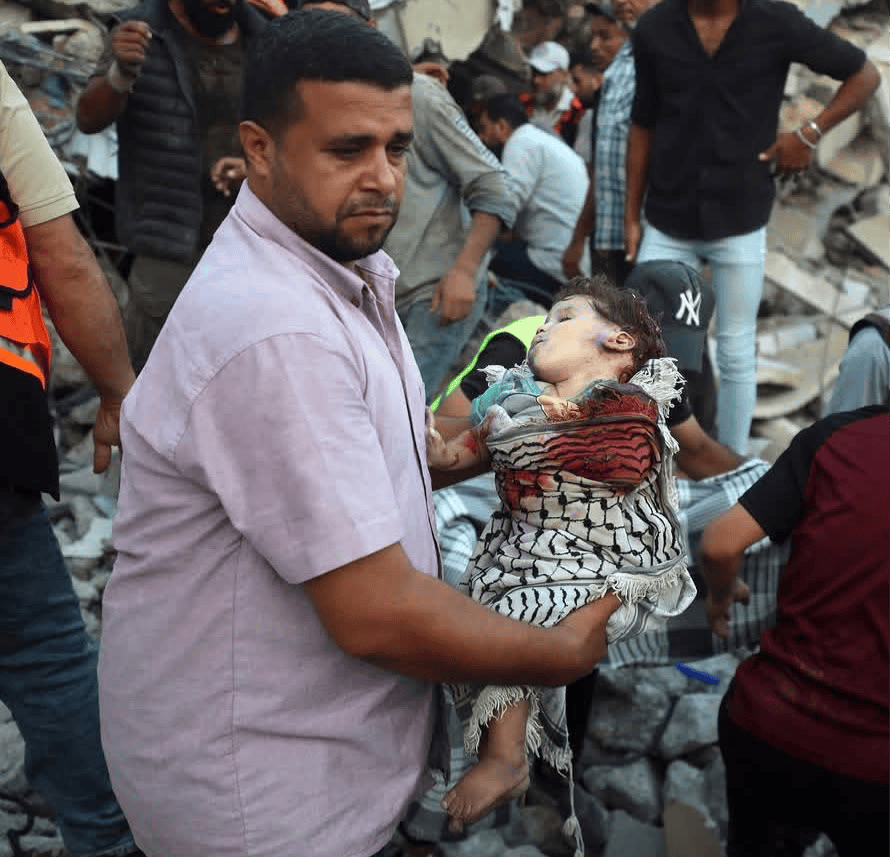
–Photograph from Gaza, shared by a local journalist and reproduced with permission—
–
What Happens to Us When We Learn Not to Look?
by Paul Alexander Wolf
Over the past few days, Gaza has been arriving on my telephone.
Not Gaza as geopolitical argument.
Not Gaza as another debate between people who have already decided what they believe.
People.
A fourteen-year-old girl with terrible burns and contractures, waiting for reconstructive treatment that cannot adequately be provided where she is.
Two little sisters facing the possibility of a devastating inherited disease, while people outside Gaza try to find some way of getting a diagnostic sample across a border.
A journalist sending photographs from among the rubble.
Then another photograph.
A child being carried from a collapsed building.
I don’t know what happened to her next.
I never will.
And perhaps that is itself part of what this war has done: not knowing has become an ordinary ending to a child’s story.
For a few moments she appeared on a telephone screen thousands of kilometres away in Australia.
Then the screen went dark, the way screens do.
And I made a cup of tea.
There is nothing wrong with making tea.
Life has to continue.
Perhaps that is precisely what frightens me.
Because while somebody carried that child through the rubble, my kettle boiled. Somewhere else somebody drove to work. Somebody complained about the traffic. Somebody chose what to have for dinner. Somebody played golf.
And gradually the unbearable becomes bearable – because it is happening somewhere else.
I find myself wondering what happens to us when we see enough suffering.
Do we become more compassionate?
Or do we eventually learn how not to look?
I fear that may be where we are with Gaza.
Not because the suffering has become smaller.
Because our capacity to be shocked by it has.
Perhaps that is why a recent sentence from Irish President Catherine Connolly stayed with me.
During President Donald Trump’s visit to Ireland, she told him that the strong view she wished to convey was that “the normalisation of war and genocide can never be accepted.” The meeting came with all the familiar choreography of state: national anthems, a guard of honour, handshakes, gifts, official photographs. Among Connolly’s gifts were a St Brigid’s Cross and the collected poems of Michael Longley, including his sonnet Ceasefire. Later that day, Trump travelled to Doonbeg, where the Irish Open was being played.
I keep returning to the word she used.
Normalisation.
Perhaps that is the word we should fear most.
Because civilisation rarely loses its conscience in one dramatic moment.
It loses it by degrees.
A bomb falls.
A hospital is damaged.
Another family is displaced.
Another child dies.
Another journalist is killed.
Another government explains.
Another ally expresses concern.
Another statement is issued.
The photographs arrive.
We look.
Then we look less.
Eventually perhaps we stop looking altogether.
The ceremony continues.
The anthem is played.
The motorcade moves on.
This is not about golf.
Presidents have schedules. So do doctors, teachers, tradespeople and parents. Human beings cannot remain paralysed by every tragedy occurring somewhere in the world.
But there is something deeply unsettling about how easily we can move from speaking about the possible destruction of a people to the ordinary business of the afternoon.
And it is not only presidents who do it.
I do it.
Most of us do.
That is why this is not really an essay about Donald Trump.
It is about us.
And about what prolonged exposure to the suffering of other human beings can do to the conscience.
I know that the word genocide divides people almost immediately.
It is a legal term. It should not be used casually.
But neither should we pretend that the accusation exists only at the margins of political argument.
The UN Independent International Commission of Inquiry concluded in 2025 that Israel had committed genocide against Palestinians in Gaza. In June 2026, the Commission reported that Israeli authorities and security forces continued to commit what it described as genocide and other atrocity crimes, including through the deliberate targeting of Palestinian children. Israel rejects the Commission’s conclusions and has disputed such allegations and the basis on which they are made.
Those disagreements matter.
Evidence matters.
Law matters.
Due process matters.
But something even more elementary matters before any court finally determines anything.
A child is a child.
Palestinian children are not Hamas.
Israeli children are not their government.
Russian children did not invade Ukraine.
Ukrainian children did not choose a battlefield.
Iranian families are not interchangeable with those who govern them.
And once we begin making ordinary people morally responsible for everything done by those who rule over them, a dangerous transformation takes place.
The citizen becomes the government.
The child becomes the combatant.
The civilian becomes collateral.
And eventually a human being becomes a category.
Categories are much easier to kill than people.
Perhaps that is why the journalists matter so much.
Since becoming involved in conversations with people inside Gaza, I have begun thinking differently about the person behind the photograph.
Someone had to stand there.
Someone had to take it.
Someone had to send it.
Someone decided that this person should not disappear without somebody outside knowing that they had existed.
Without the journalist we receive numbers.
With the journalist, sometimes, we receive a face.
The Committee to Protect Journalists has repeatedly reviewed its own figures during this war. In June 2026 it removed twenty names after further investigation, including eight people for whom evidence established participation in combat. Even after that review, CPJ said it had documented 209 journalists and media workers killed by Israel in Gaza and in Israeli detention centres since October 2023. CPJ says it has determined that at least 75 journalists and media workers were directly targeted and killed by Israeli forces in reprisal for their work, while cautioning that the true figure may be higher because verification in Gaza is extraordinarily difficult.
That correction matters.
Because this is not a number that had to be protected from scrutiny.
It was scrutinised.
And remained catastrophic.
The person who sends us today’s photograph may become tomorrow’s photograph.
I do not want to become accustomed to that either.
Which brings me to leadership.
I grew up believing – perhaps idealistically – that leadership carried responsibilities beyond winning.
Beyond dominance.
Beyond protecting one’s own constituency.
Beyond proving that one’s military is stronger than somebody else’s.
Leadership at its best involves restraint.
It understands that possessing enormous power and being morally entitled to exercise all of it are not the same thing.
History’s better leaders were not perfect people.
None were.
But some understood something we appear in danger of forgetting:
Strength is not measured only by what you are capable of doing.
Sometimes it is measured by what you refuse to do.
I still listen occasionally to Martin Luther King Jr.
There was enormous anger in the world around him.
There must have been anger within him.
How could there not have been?
He saw humiliation, segregation, brutality and murder.
Yet he refused to allow anger to decide what another human being was worth.
That remains extraordinary to me.
King had no army.
No nuclear codes.
No presidential aircraft.
No battalions waiting for his instruction.
Yet he understood something that all the machinery of modern power cannot teach:
Hatred eventually changes the person who carries it.
Anger may sometimes be necessary.
Indifference can be morally worse.
But anger and hatred are not the same thing.
And grief – even terrible grief – does not confer the right to decide that another innocent life has become expendable.
I sometimes struggle with the strange normality of political power.
Decisions are made in offices which may determine whether people thousands of kilometres away live or die.
Then the meeting ends.
The folder closes.
Cars leave.
Dinner is served.
Someone attends a reception.
Someone plays golf.
Someone enters a church, synagogue or mosque.
Perhaps somebody bows the head in prayer.
And I wonder what prayer means when it never reaches the conscience.
What is faith worth if it accompanies us into a place of worship but refuses to accompany us into the room where power is exercised?
A Bible cannot make a bomb moral.
A Torah cannot make a starving child less hungry.
A Qur’an cannot excuse torture.
And having no religion does not relieve anyone of the same human obligation.
Faith, if it means anything, should make the suffering of somebody outside our tribe more visible, not less.
Nor should political office become sanctuary from accountability.
Where credible evidence exists of war crimes, crimes against humanity or genocide, it should be investigated independently.
Evidence should be tested.
Accusations should be answered.
Guilt should be established through law rather than slogans.
And where criminal responsibility is established, neither office, flag, religion nor alliance should place anyone beyond consequence.
Sometimes consequence may include a prison cell.
Not because vengeance is justice.
It isn’t.
But because power without accountability eventually teaches power that almost anything can be survived.
And perhaps a prison cell, stripped of motorcades, entourage and applause, can sometimes become a quieter place in which to encounter one’s conscience.
History, regrettably, has often been kinder to those who commanded suffering than to those who endured it.
And Gaza is not the only warning.
Ukraine continues.
Other wars continue.
Governments continue to imprison, brutalise and kill.
Today we fight over territory, security and power.
Tomorrow increasingly it may be water.
Food.
Energy.
Migration.
Resources altered by a changing climate.
We have developed weapons previous generations could scarcely have imagined while carrying within ourselves instincts they would recognise immediately: fear, tribalism, vengeance, greed and the desire to dominate.
Technologically, humanity has become astonishingly sophisticated.
Morally, I am less certain how far we have travelled.
Perhaps one of the great questions of this century is therefore not whether our weapons will become more powerful.
They will.
It is whether our wisdom can grow quickly enough to restrain them.
And then there are the people in between.
Perhaps history’s greatest atrocities have never depended only upon the person giving the order.
They have also required people willing to accommodate the order.
People who explain.
People who rationalise.
People who soften the language.
People who decide that an alliance matters more than consistency.
People who discover international law when an enemy violates it and ambiguity when a friend does.
People who are simply tired.
People like us, perhaps, who have seen so many photographs that another dead child becomes one photograph too many.
So we scroll past.
That may be how conscience disappears.
Not with applause for cruelty.
With exhaustion.
With distraction.
With the quiet decision that there is nothing more we can do.
And perhaps there isn’t very much.
I cannot stop a war.
I cannot open a border.
I cannot protect the journalist who sends the next photograph.
I cannot reach into that photograph and take the child from the arms of the person carrying her.
Most of us cannot.
But perhaps there is still something we can refuse.
We can refuse to become accustomed to it.
We can refuse to decide whose child matters according to nationality.
We can refuse to believe that compassion for a Palestinian somehow requires indifference to an Israeli, or that solidarity with a Ukrainian requires hatred of an ordinary Russian.
We can refuse the convenient morality in which the crimes of our enemies are atrocities and the suffering caused by our friends requires further context.
We can continue supporting the people who heal.
The people who rescue.
The people who document.
The people who negotiate.
The people who continue building bridges while other people are destroying them.
And perhaps, above all, we can keep looking.
Not voyeuristically.
Not because another photograph of another dead child is something the world should consume.
But because looking away has consequences too.
The child whose photograph appeared on my telephone may have survived.
She may not have.
I don’t know.
Somebody knows.
Somebody knows her name.
Somebody remembers the sound of her voice.
Somebody may have kissed her forehead before she went to sleep.
Somebody may still be waiting for her.
For a moment, thousands of kilometres away, she became visible to me.
Then my telephone went dark.
And I made tea.
I keep returning to that ordinary little moment.
Because perhaps the most frightening thing about Gaza is no longer only what human beings have been willing to do to one another.
It is what the rest of us may gradually become willing not to see.
The great danger is not only that war becomes normal.
It is that the child becomes normal.
The rubble becomes normal.
The hunger becomes normal.
The explanation becomes normal.
And eventually our looking away becomes normal too.
Perhaps civilisation begins with something much smaller than treaties, summits and speeches.
Perhaps it begins when one human being looks at another and recognises:
Your life is not worth less because you were born somewhere else.
And perhaps civilisation begins to fail at exactly the moment we can look at a child being carried from the rubble –
and feel almost nothing at all.

