by Paul Wolf
The modern Middle East stands once again at the edge of a dangerous illusion – the belief that absolute security can ultimately be achieved through the total defeat of one’s adversary.
The escalating confrontation involving Iran, Israel, and the United States is often framed in the language of victory, deterrence, retaliation, and dominance. Yet history repeatedly suggests that conflicts shaped by existential fear rarely end through decisive triumph. More often, they harden into cycles of escalation that gradually reshape entire societies around insecurity, mobilisation, and distrust.
At the centre of this crisis lies the Strait of Hormuz – a narrow maritime corridor through which a substantial share of the world’s energy supply passes. A disruption there would not remain a regional event for long. It would ripple outward through global shipping, inflation, energy markets, political systems, and already fragile economies.
But perhaps the deeper danger of our age is not only military escalation.
It is the gradual normalisation of escalation itself.
The modern world has become deeply interconnected, technologically accelerated, economically fragile, and increasingly reactive. Under such conditions, even limited confrontation can trigger consequences far larger than those who initiated it intended. A strike on infrastructure, a widening cycle of retaliation, or a miscalculation at sea could generate political and economic shockwaves affecting millions far removed from the battlefield.
History suggests that nations often enter periods of confrontation believing escalation will remain controlled and strategically manageable. Yet wars frequently evolve according to dynamics larger than the assumptions that began them. Fear of appearing weak, domestic political pressure, alliance obligations, and cycles of retaliation can gradually narrow the space for restraint until leaders themselves become trapped inside systems they no longer fully control.
Reaction slowly begins replacing reflection.
Escalation begins replacing strategy.
And over time, entire societies can begin reorganising themselves emotionally around fear.
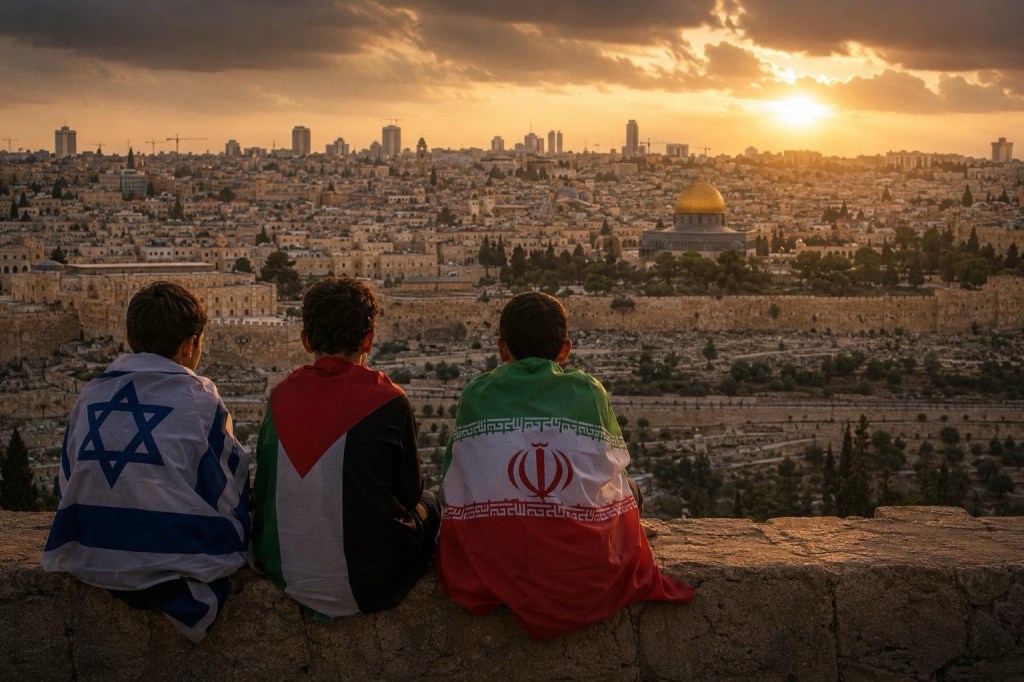
Across the region, generations now grow up learning the language of deterrence before the language of coexistence. In parts of Israel, families live beneath the persistent fear of missile attacks and existential vulnerability. In Iran, younger generations have grown up under sanctions, isolation, and the constant rhetoric of external threat. Palestinians continue living with displacement, fragmentation, insecurity, and the inheritance of unresolved conflict.
No child in the region is born fearing another civilisation.
Fear is inherited gradually – through trauma, memory, politics, and generations shaped by instability.
These realities do not cancel one another out.
They coexist – painfully, simultaneously, and unresolved.
Yet modern political discourse increasingly pushes societies toward simplification. One side is expected to embody civilisation, the other barbarism; one side security, the other aggression. Such narratives may provide emotional clarity during crisis, but they rarely produce durable strategic wisdom.
The first challenge facing all major actors is therefore remarkably simple, though politically difficult to answer honestly:
What, in realistic terms, is the desired end state?
For the United States, the objectives include preventing nuclear proliferation, protecting maritime trade, reassuring allies, and avoiding uncontrolled regional war. For Israel, the overriding concern remains long-term survival and protection against existential threats. For Iran, the priorities include regime survival, sovereignty, deterrence, and resistance to perceived external domination. For Palestinians, the central issues remain dignity, recognition, security, and the hope of a future not permanently defined by conflict.
Yet recognising legitimate objectives is not the same as believing all objectives are fully achievable through force.
This is where the illusion of total victory begins to reveal itself.
Military superiority can destroy infrastructure, delay weapons programmes, and impose severe strategic costs. Economic sanctions can weaken economies and restrict state capability. Proxy warfare can expand influence and destabilise adversaries. Yet none of these instruments easily resolves conflicts rooted in identity, historical memory, humiliation, and existential fear.
Tactical success and strategic wisdom are not always the same thing.
History repeatedly demonstrates that nations can win battles and still weaken their long-term political stability, legitimacy, or strategic position. Conversely, some of the most enduring periods of stability emerged not through total domination, but through systems capable of balancing deterrence with coexistence.
The purpose of deterrence, ultimately, is not permanent war.
It is the prevention of catastrophic war.
Stable geopolitical orders are rarely built upon the permanent humiliation of major societies. Deterrence seeks to establish limits and consequences. Humiliation seeks psychological submission. The difference between the two is not merely moral; it is profoundly strategic.
Societies that believe they retain dignity, sovereignty, and some future within the international system are often more capable of gradual evolution and pragmatic compromise. Societies that feel permanently cornered or collectively degraded may instead become more radicalised, more militarised, and more willing to embrace extreme risks.
Fear may help societies survive immediate danger.
It cannot by itself build a stable future.
Perhaps one of the deepest tragedies of prolonged conflict is that societies can gradually become more afraid of coexistence than of escalation itself.
Perhaps this is why peace processes so often prove more fragile than outsiders expect.
They fail not only because enemies resist them. They also fail because societies shaped by prolonged fear often struggle psychologically to absorb rapid transition. Leaders who attempt strategic opening frequently face danger not only from adversaries, but from factions within their own political, military, or ideological circles.
The experience of Anwar Sadat remains deeply instructive. His opening toward Israel transformed the strategic landscape of the Middle East, yet also provoked fierce opposition within Egypt and ultimately contributed to his assassination. Likewise, the optimism surrounding the Oslo Accords encountered profound resistance from hardliners across multiple sides of the conflict. Yitzhak Rabin himself was assassinated by an Israeli extremist opposed to the peace process.
Political transitions that move too quickly without sufficient legitimacy, inclusion, and psychological preparation can destabilise the very leaders attempting to prevent conflict.
Statesmanship therefore requires not only courage, but calibration.
This was one of the profound insights behind John F. Kennedy’s American University speech during the Cold War. Kennedy did not abandon deterrence or minimise the dangers posed by the Soviet system. Yet after the Cuban Missile Crisis, he recognised that nuclear-age survival required something more than permanent dehumanisation of adversaries.
He deliberately acknowledged the suffering, history, and humanity of the Soviet people while maintaining strategic firmness toward the Soviet state. Parts of the American security establishment viewed such rhetoric with suspicion at the time. Yet Kennedy understood something many societies struggle to accept during periods of fear: coexistence does not require abandoning vigilance, but it does require resisting the temptation to psychologically imprison entire peoples inside permanent enemy imagery.
That balance remains extraordinarily difficult.
In periods of prolonged tension, restraint rarely receives immediate applause. Escalation often appears emotionally clearer, politically safer, and psychologically simpler. Yet history repeatedly suggests that the survival of civilisations may depend precisely on leaders willing to resist those pressures.
Perhaps this is what makes the current moment so dangerous. Not only the weapons themselves, but the gradual erosion of confidence that restraint is still politically possible.
The challenge is therefore not simply reaching agreements.
It is carrying societies through fear without allowing fear to permanently govern the future.
History suggests this requires patience.
Few believed during the early decades of the Cold War that the confrontation between Washington and Moscow would eventually soften without direct superpower war. Few imagined the later reconciliation between the United States and Vietnam. Even the peace agreements between Egypt and Israel once appeared politically impossible.
History does not guarantee progress.
But neither does it suggest that societies remain permanently frozen in their most dangerous moments.
Over time, political systems evolve. Generations change. Economic pressures reshape priorities. Populations exhausted by instability gradually begin seeking futures different from those imagined during periods of revolutionary fervour or existential mobilisation.
In an age of instantaneous reaction, strategic patience can begin to feel almost countercultural.
Yet the discipline of statesmanship lies not merely in reacting forcefully to immediate provocation, but in asking whether present actions preserve or destroy future possibility. Tactical escalation may generate short-term political satisfaction while weakening long-term strategic stability. Restraint, though often politically difficult, may preserve conditions under which future evolution remains possible.
The purpose of responsible power is not merely to prevail in moments of crisis.
It is to preserve the future beyond them.
The Middle East does not require naive idealism. Security threats are real. Deterrence remains necessary. Violent actors cannot simply be wished away. But realism in the nuclear and technological age may now require something deeper than perpetual escalation alone. It may require recognising that absolute security pursued without restraint can itself become destabilising.
Modern societies possess immense technological power, yet often seem increasingly uncertain about how to exercise restraint under pressure. Public discourse rewards outrage faster than reflection. Political systems struggle to think beyond immediate crisis cycles. Entire populations now live beneath constant streams of fear, reaction, and confrontation.
People can survive fear for long periods.
Few societies remain healthy when fear becomes identity.
No society can remain psychologically mobilised forever without eventually losing part of itself.
A civilisation permanently preparing for catastrophe eventually risks forgetting what stability was meant to protect.
In the end, most people simply wish to live ordinary lives without handing permanent fear to their children.
The Middle East does not need illusions of perfect harmony. It needs leaders capable of balancing strength with wisdom, deterrence with dignity, and vigilance with enough political imagination to prevent entire generations from inheriting endless confrontation as emotional destiny.
The hardest thing for nations under pressure is often not strength, but remembering what strength is ultimately meant to protect.
Future generations may not remember every military operation, sanction, or diplomatic standoff that defined this era. But they may remember whether leaders and societies possessed enough wisdom to prevent fear from becoming the permanent inheritance of future generations.

