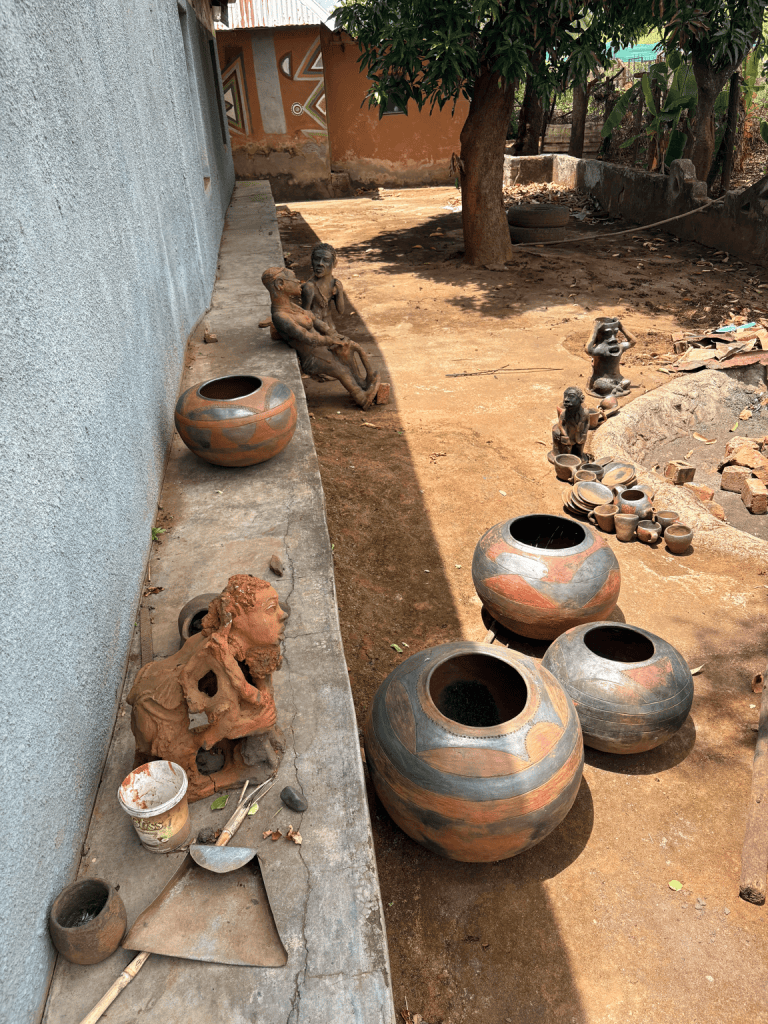
At Dr Noria Mabasa’s workplace, where clay, memory and story meet.
–
At five in the morning, back home in the Fleurieu Peninsula , I woke with the Venda road still before me. The journey was over, but my mind was travelling again: along the dusty roads, towards the mountains, through places I had known as a young doctor and had not truly understood until now.
At Tshilwavhusiku, Betty and I stood beside the house that had been prepared for us more than thirty-five years earlier. We had imagined making our life there together. I was to become the clinic’s first permanent doctor, serving two other clinics as well. We were only weeks from moving when life turned us elsewhere. The acacia tree was still standing. The house had found another purpose. For a moment, the years seemed to fold in on themselves: the future we had planned, the life we had lived, and the people now carrying the work forward.
The clinic brought the present into that moment. It still depended on one visiting doctor. The nurses spoke about the burdens they carried, including the wounds domestic and sexual violence leave in people’s lives. I could not mend what I heard in one visit. I could listen. As we left, their words came with us.
Then the road ran on towards the mountains. A friend who knew this land began to show us what I had once passed without seeing. He spoke of King Makhado and of Songozwi, the mountain stronghold from which a king fought for his people and their land. Across the dust, the distant mountains no longer seemed like scenery. They held memory, courage and the lives of a people. I tried to picture the refuge cave we had heard about, and the struggle carried out in that landscape. I had lived nearby as a young doctor; only now was I beginning to see how much history the land held.
I thought of David, the shepherd before he became king. Psalm 23 does not pretend that the valley is empty, or that sorrow will pass us by. It speaks of a presence that does not abandon us there. As the road unfolded, “The Lord is my shepherd” became a quiet refrain beneath all that we were seeing and hearing.
On that last Sunday at Siloam, we walked the dusty roads and spent time with Patrick and others. We met elderly people who had served the hospital long ago. Memories came into focus, then drifted away again. I could not hold the past still for them. I could be present, listen, and recognise lives that had helped shape Siloam. The years were there between us, both in what could still be remembered and in what was beginning to fade.
I remember the families who welcomed us, and the singing. The voices rose together with a warmth and strength I can still hear. At Takalani, Rinah and her staff moved me with their dedication. The children touched me most. They were not an idea, or a cause, or a line in a report. They were children we had met, each with a life unfolding and a future deserving care.
The people who brought us into these places had their own stories of service. One had travelled from Mushaathoni into law and diplomacy, across the world, and then returned to invest in the community that had helped shape him. Another had written about the difficult journey of understanding her mother’s story, while her work and mentoring brought her close to people who needed care. Their paths were different, but they met in a shared commitment to young people and to the future. They welcomed us into the places, relationships and work that mattered to them.
The old ache of the future Betty and I did not have at Tshilwavhusiku came home with me. But it was no longer alone. It sat beside the nurses’ voices, the elders’ years of service, the families’ song, the children at Takalani and the commitment to the next generation. What began as a return to a place in my past had become an encounter with other people’s lives in the present. My heart is still, in part, in Siloam: not in the past I left there, but in the work that still needs to be done. Perhaps that is why the journey has not simply ended with our return.
Since coming home, one question keeps returning: what does life ask of us? Not what can we take from a journey, or how can we enrich ourselves, but what can we bring forth through compassion? What does the person before us need? What do we owe one another, and those who will come after us? Sometimes an answer costs time, comfort or security. Sometimes care asks for sacrifice.
A crisis far away, even one as terrible as Gaza, can rightly call us to compassion. But compassion does not begin only when we travel to a distant place. It can deepen wherever another person’s life is allowed to matter: in a clinic, beside an elder, among children, or in a family’s welcome and song. The journey made suffering less abstract to me. Human connection brought it close, and with it the question of how I should respond.
Some of these memories still wake me at night. I feel gratitude, and I feel how quickly time passes. Our choices matter, not only for ourselves, but for those who come within our care and for the future we help shape. The question is not only what happened to us, or what this journey added to my life. It is what I can now bring to the lives entrusted to me.
Whatever service may grow from this journey, I leave with the One who created us. He can use the ground we have all walked and the choices we have made, held within a greater grace and love. We may not see what will grow from it, or understand its meaning now. We can still answer the need before us, with whatever compassion and courage we have.
The Lord is my shepherd. Not because the road is easy, or because I know where it leads. Because we are called to walk it with one another, and to give what love asks of us along the way.
Paul Wolf

