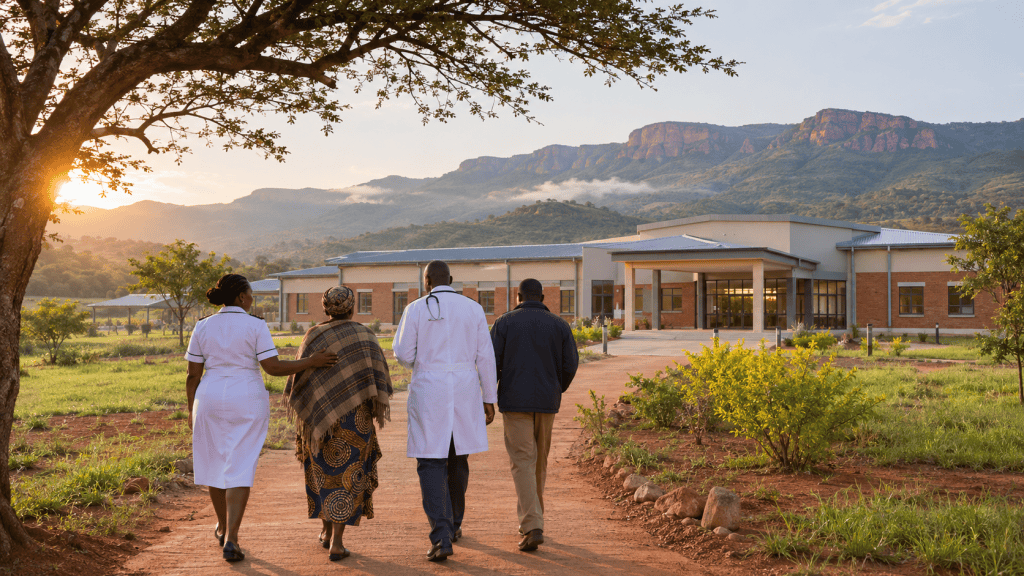
Illustrative image – not a photograph of Siloam Hospital.
–
Reflections on a return to Venda, rural healthcare and the work that makes institutions function
By Dr Paul Alexander Wolf, FRACGP
Fleurieu Peninsula, South Australia | November 2026
A new hospital is a visible promise. Its buildings, wards and equipment can represent investment and hope. But patients experience a health service through the people who care for them, the continuity of that care and the systems that support it.
That distinction stayed with me during my return to Venda after more than thirty-five years. I came without a predetermined professional agenda. I returned to places that had shaped me, listened to people working in them and tried to understand what had changed – and what questions remain.
This article is a personal reflection, not a formal assessment of Siloam Hospital, the Limpopo Department of Health or the University of Venda. I did not have the time or information required to evaluate their services comprehensively. I will distinguish, as carefully as I can, between what I observed, what people told me and what published sources report.
The sequence of the homecoming
Our first day in Venda took us to Tshilwavhusiku Clinic. More than thirty-five years earlier, my wife Betty and I had been preparing to move into a house there. I was expected to become the clinic’s first permanently based doctor, also serving two other clinics. We were only weeks away from moving when circumstances took our family in another direction.
The clinic had expanded, and its infrastructure showed clear signs of change. I was told, however, that it continued to rely on a visiting doctor, attending approximately once a month. Nurses described the responsibilities they carried, including caring for people affected by domestic and sexual violence.
I could not verify the service’s full staffing arrangements or assess the quality and continuity of care from one visit. Nor could I compare today’s burden of disease with that of 1990. What I could do was listen – and recognise that the question of dependable medical support for rural clinics had not disappeared.
The following day, I attended a strategic meeting at the University of Venda. I had prepared a separate public address, “Knowledge That Returns Home,” but it was not delivered because the university had examinations that day. The strategic discussion was thoughtful and included valuable perspectives. It explored how UNIVEN’s health-sciences work might relate to the needs of the region and the communities it serves. It did not settle on the shared research question I had hoped we might explore, but it clarified some of the context and showed me how much expertise and responsibility already sit within South African institutions.
The visits that followed included Mushaathoni Secondary School, Siloam Hospital, Takalani Children’s Home, artists’ workplaces, traditional leaders and community settings. On the final Sunday, after a church service in Thohoyandou, we returned to Siloam village instead of continuing with the planned Kruger visit. We walked the dusty roads and spoke with people who had known the hospital in earlier years. That return made the journey feel less like a sequence of appointments and more like an opportunity to listen to people whose lives were connected to the place.
What a visit can – and cannot – tell us
At Siloam, I saw new hospital infrastructure and paper patient records. People described the demands facing services and the importance of improving clinical support. Some residents spoke with affection about the doctors from Dr Evert Helms’ era, remembering them as caring. I understood those comments as expressions of trust, continuity and personal connection.
These are observations and conversations, not a clinical audit. I did not assess the hospital’s records system as a whole, review patient outcomes, examine staffing data or interview a representative sample of patients and staff. A brief visit cannot establish whether the burden of disease has risen or fallen, whether the hospital is clinically prepared for every service it plans to provide, or how consistently its clinics and referral pathways function.
The questions are still important. They should be investigated through appropriate local processes, with the people who work in and rely upon the services involved in defining what needs to be understood.
A building is not yet a functioning hospital
Published reports describe a substantial investment in Siloam’s new hospital. They also give different project costs, completion expectations and descriptions of progress.
A Limpopo Legislature oversight visit in July 2026 reported that the existing hospital had 350 approved beds, of which 220 were usable, and served 15 referring clinics. The new facility is described as a 224-bed hospital.
The National Department of Health’s 2026-27 plan includes information technology, training and clinical engineering among the project components. A September 2026 news report described practical completion as having occurred on 3 August.
Those reports are useful, but they do not by themselves answer the questions that matter to patients and staff. “Practical completion” is not the same as a hospital being fully operational. A plan that includes IT or training does not establish that a reliable, integrated system is in place or will be maintained.
Published cost estimates range from about R1.4 billion to R1.6 billion across different dates and sources. That spread prompts a straightforward question: are the figures describing the same scope, the same stage of the project and the same basis of calculation? Before drawing conclusions, the estimates need to be reconciled.
The investment also raises a wider question – not an accusation, but a question worth examining. What balance of investment is most likely to improve healthcare across the district? A new hospital may be essential. At the same time, primary-care clinics, staff support, referral systems, training, records and supervision also require attention. Could investment across these connected services improve access, continuity and the use of hospital capacity? That is a proposition to test with evidence and local knowledge, not an outcome to assume.
The whole district matters
A district hospital does not function alone. Its patients arrive from clinics and communities; its clinicians depend on referral pathways, transport, communication and access to appropriate advice. The hospital’s effectiveness is therefore connected to the strength of the services around it.
At Tshilwavhusiku, I was told that one visiting doctor attended about once a month. Nurses described the breadth of their responsibilities. These accounts deserve to be taken seriously, while their wider significance should be established through local service data and discussion with staff and patients.
A useful inquiry might ask how clinics obtain timely medical advice; how referrals are made and followed up; what supervision is available to nurses and younger doctors; and whether patient information can be accessed reliably across settings. It might also ask what support clinicians say they need to remain and develop in rural practice.
These are not questions one visiting doctor can answer. They call for the knowledge of local clinicians, managers, educators, communities and the Department of Health.
The ground before the school
At UNIVEN, I hoped to explore how health-sciences education could connect with clinical services and community needs. My earlier phrase, “prepare the ground before building the school,” was intended to emphasise the importance of supervision, clinical learning environments and strong services.
I now see that the relationship is not simply one-way. Education may help strengthen clinical services by supporting supervision, professional development and a culture of learning. Strong clinical services, in turn, give students and early-career professionals a better environment in which to learn.
The practical question is how local institutions might develop those relationships in ways they consider useful and sustainable. A small, clearly defined collaboration could be one way to learn: perhaps structured mentorship, clinical education or support for links between a district hospital and surrounding clinics. But the subject, leadership and priorities would need to come from the people and institutions responsible for the work.
A programme should not be assumed to be needed simply because it is possible to create one. It should respond to an identified need, have clear responsibilities and be judged by what it contributes to education and care.
Leadership, teams and the ordinary working day
Buildings, equipment and plans matter. So do the people who make a service work each day: nurses, doctors, midwives, allied health professionals, administrative and technical staff, educators and community-based workers.
A hospital’s clinical culture is shaped by whether people can communicate, learn from difficulties, ask for help and raise concerns about patient safety. It depends on appropriate supervision and leaders who understand the clinical work as well as the administrative responsibilities surrounding it.
These are general principles, not findings about Siloam’s current leadership. I did not have the access or evidence to make such a judgement. But they are relevant questions for any hospital preparing to deliver services in a new facility:
- Who supports a clinician facing a difficult case?
- How are skills and emergency preparedness maintained?
- How do teams learn from adverse events and near misses?
- Can frontline staff raise concerns and have them considered?
- How are the hospital and its surrounding clinics supported to work together?
A new hospital creates an opportunity to consider these matters alongside the physical transition. Its success will depend not only on the building being ready, but also on the people, relationships and systems needed to make its services dependable.
My own place in this
I have worked in rural and district medicine in several countries. That experience gives me some useful perspectives, but it does not make me an authority on what Siloam or Vhembe needs today. Local knowledge and institutional responsibility must lead. Should a need arise that cannot be met within South Africa, I would always be willing to listen.
Gratitude for the people who made the journey possible
I am grateful to the Limpopo Department of Health and the Siloam Hospital CEO for facilitating our visits and making time for us. I also thank the University of Venda and everyone who welcomed us at the institutions, schools, clinics and community projects we visited.
Thivhilaeli and Rebecca Makatu made the journey possible through their organisation, introductions, hospitality and continuing support. I am grateful to them and to all the people who shared their time and experience.
Betty’s contribution was quieter but essential. As a professional weaver, she brought her own interest in the artists and their work, and the visits to Dr Noria Mabasa and other artists were especially meaningful to her. She also supported me in the background throughout the homecoming – helping me prepare, adapting to last-minute changes and working with me on revisions to speeches and presentations. The final walk through Siloam village and conversations with local people were deeply moving for her, particularly as she heard accounts of the difficulties people experience in accessing care.
Her support allowed me to meet the journey as it unfolded, rather than as we had first planned it.
The questions beyond the building
I returned to Venda with memories of Siloam and Tshilwavhusiku. I left with renewed friendships, gratitude for those continuing to serve, and a clearer sense of how much remains to be understood.
The new hospital is a significant investment and an opportunity. Whether it fulfils its promise will depend on more than construction milestones. It will depend on clinical readiness, capable teams, reliable systems, good connections with surrounding clinics and an education environment that supports the people delivering care.
Those are questions for local professionals, institutions and communities to shape and answer. Any contribution from outside should begin by listening to them.
Before we judge what a hospital can do, we need to understand the services around it and the people who will make it work.
Before we propose a solution, we need to know what local evidence and experience show.
And before we decide what should happen next, the answers must begin locally.
References
- GroundUp, “Dilapidated Limpopo hospital has to send its laundry 30km away to be washed,” 13 July 2022. The article attributes a R1.5-billion estimate and July 2028 completion target to the National Department of Health.
- Limpopo Mirror (Zoutnet), “Construction at Siloam hospital now at 34%, but not everyone is happy,” 30 March 2024. The article reports a budget of over R1.4 billion.
- National Department of Health, Annual Performance Plan 2026-2027. The Siloam project description includes IT services, training and clinical engineering.
- Limpopo Legislature, Portfolio Committee on Health, unannounced oversight visit to Siloam District Hospital, 7 July 2026. The Legislature’s online record reports 350 approved beds, 220 usable beds and 15 referring clinics.
- Review, “New 224-bed Siloam Hospital to boost Vhembe healthcare,” 29 September 2026. The report gives 3 August as the practical-completion date and reports a project cost of R1.37 billion.
- Limpopo Provincial Government, Limpopo Development Plan 2025-2030. The plan cites a R1.6-billion cost and gives a dated progress and completion projection.

