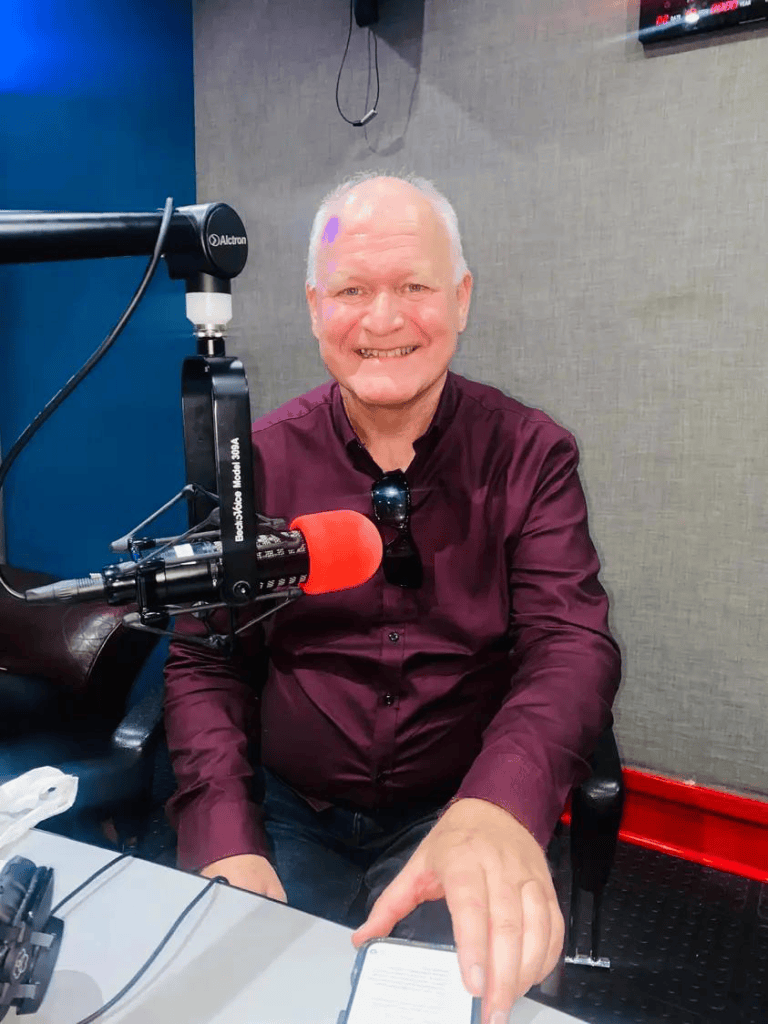
Dr Paul Wolf during a radio interview in Venda, South Africa, October 2026.
–
Reflections on Rural Healthcare, Leadership and Knowing One’s Limits
By Dr Paul Wolf, FRACGP
Cape Town, South Africa | 28 October 2026
More questions than answers
I returned from Venda with considerably more questions than answers.
The days since leaving have given me an opportunity to reflect more deeply upon what my wife Betty and I encountered during two extraordinary weeks travelling through Mopani and Venda in northeastern South Africa.
Conversations with experienced colleagues have challenged some of my assumptions and helped me better appreciate the complexities of rural healthcare.
I began with observations, questions and a few convictions.
I have come away with a greater appreciation of the limits of my own perspective, the value of experience different from mine, and the importance of recognising what I do not yet understand.
The assessments and opinions that follow are entirely my own. They do not represent the views of any individual or institution.
The question that followed me from Venda
In my previous article, The Acacia Tree Was Still Standing, I described returning to Tshilwavhusiku Clinic, where more than thirty-five years ago Betty and I were only weeks away from moving into a house built for us, so that I could become the clinic’s first permanently based doctor.
The clinic has expanded and its infrastructure has improved considerably. But I was told that it continues to depend upon a visiting doctor, now attending approximately once a month.
The nurses spoke about the considerable responsibilities they carry, including caring for patients affected by domestic violence and sexual violence.
Their commitment deserves recognition.
Nurse-led healthcare is not an inferior form of healthcare. In many rural communities, experienced nurses provide skilled, compassionate and continuous care, often under demanding circumstances.
But even the most capable nurses need dependable clinical support, appropriate training, clear referral pathways and access to medical advice when circumstances require it.
I could not establish the full circumstances of the service from one visit, nor could I reliably compare today’s disease burden with that of 1990.
Nevertheless, the experience raised a question that has remained with me.
How do we ensure that improvements in healthcare infrastructure are accompanied by equally meaningful improvements in access to continuous, dependable clinical care?
Rural healthcare is not simply a matter of buildings, equipment or occasional medical visits.
It requires a system that supports patients and the professionals responsible for their care.
And that system must work every day, not only when a visiting doctor arrives.
A new hospital, an old question
The new district-hospital infrastructure at Siloam represents a substantial investment in the future of healthcare in Vhembe.
That is something to welcome.
Patients deserve modern facilities, and healthcare professionals deserve safe environments in which to practise.
But a hospital is not simply a physical structure.
It is an organisation of people, responsibilities, clinical relationships and professional values.
It needs capable leadership, appropriate staffing, clinical governance, supervision and a culture in which learning and accountability are taken seriously.
And it must function as part of a wider network of clinics, community services and referral hospitals.
These observations are not a judgement on the present management or performance of Siloam Hospital. My brief visit provided no basis for such an assessment.
They are questions that apply to healthcare institutions everywhere.
How does a district hospital develop a strong clinical culture?
How does it attract and retain capable professionals?
How can experienced clinicians support younger colleagues?
And how do we ensure that investment in buildings is matched by an equally serious investment in the people who make those buildings meaningful?
A new building may be completed on a particular date.
Developing a strong institution, however, is a continuing process.
The complexity behind the obvious solution
One of the clearest lessons since leaving Venda is that the difficulties facing rural healthcare cannot be resolved through clinical enthusiasm alone.
Healthcare institutions operate within complex administrative, financial, professional and political environments.
Appointments, budgets, staffing and governance are not matters that a single enthusiastic doctor can simply rearrange.
Even excellent clinical ideas may fail without appropriate leadership, resources, authority and sustained local support.
I have found myself reflecting on the difference between being willing to help and being equipped and authorised to assume responsibility.
They are not necessarily the same thing.
My professional experience is predominantly clinical. Over more than thirty-five years, I have worked in rural and district medicine across several countries, including emergency care, clinical supervision, medical education and the realities of practising where resources are limited.
That experience has value.
It also has boundaries.
Developing a major public hospital or establishing a new medical faculty requires expertise in institutional governance, public administration, workforce planning, finance, accreditation and organisational change.
These are specialised disciplines, and no amount of clinical experience automatically confers mastery of them.
Recognising that distinction does not diminish the value of clinical experience.
It helps establish where that experience can be most useful.
Passion is valuable. But passion is not a substitute for governance, authority or institutional competence.
And goodwill, however sincere, cannot replace the structures necessary to turn worthwhile ideas into sustainable services.
The importance of South African expertise
The future of rural healthcare in Limpopo should be shaped primarily by people who understand the South African healthcare system and the particular circumstances of the province.
South Africa has universities, medical schools, family-medicine departments and experienced healthcare professionals whose expertise deserves to be sought and valued.
Their understanding extends beyond medicine itself to provincial administration, workforce challenges, professional relationships and the communities being served.
That knowledge matters.
Experience from elsewhere can certainly contribute.
Sometimes an outside perspective helps identify possibilities that those working within a system may not immediately recognise. Collaboration across institutions and national borders can also be valuable.
But such contributions should respond to clearly identified needs and operate within arrangements supported by those responsible locally.
They should not begin with an outsider arriving to announce what needs to be done.
The people who live and work in these communities must remain central to their future.
The purpose of outside experience should be to strengthen local capability, not replace local ownership.
Preparing the ground
In my previous article, I asked what kind of doctor Vhembe actually needs, a question I also brought to a strategic conversation at the University of Venda.
Students learn not only from teaching methods, but from the clinical environments in which they work: the example of their supervisors, the culture of their institutions and the quality of the services in which they train.
That is why I have repeatedly returned to one conviction.
Prepare the ground before building the school.
Clinical services, supervision, teamwork and professional culture matter enormously.
But I have also come to recognise that the relationship may not be quite so simple.
Perhaps some clinical foundations must be established before medical education can expand.
Or perhaps medical education and clinical services can be strengthened together, each contributing to the development of the other.
A medical school may help attract and retain clinicians, stimulate research, strengthen supervision and encourage a culture of learning.
Equally, a strong clinical environment provides the foundation upon which meaningful medical education depends.
The school may help cultivate the ground.
And the ground may help shape the school.
The important question may therefore be less about which must come first and more about how both can develop together, realistically and sustainably.
That question deserves the attention of South African educators, clinicians and institutional leaders who have already confronted similar challenges.
I hope it receives it.
The contribution of family medicine
A district hospital cannot function effectively in isolation from the clinics and communities around it.
When chronic diseases are poorly managed, complications eventually arrive at hospital.
When serious illness is recognised too late, opportunities for earlier intervention may be lost.
And when rural healthcare professionals lack adequate clinical support, patients may bear the consequences.
Strong primary care is therefore not merely about reducing the workload of a hospital.
It is about improving the quality, safety and continuity of care throughout the healthcare system.
Family physicians and experienced generalists can contribute far beyond their own consultations.
They can supervise and mentor clinicians, support nurse-led services, strengthen referral pathways, contribute to quality improvement and help develop the next generation of doctors.
They can also encourage professional cultures in which knowledge is shared, uncertainty can be discussed openly and patient safety remains central.
But these responsibilities require time, resources and proper organisation.
They cannot simply be added indefinitely to the workload of already overstretched clinicians.
Nor should the contribution of nurses, community health workers and other healthcare professionals be overlooked.
Effective rural healthcare depends upon teams whose members have different skills, responsibilities and levels of expertise, supported by systems that allow them to work together.
The question is not whether family medicine has an important role.
It is how that role can be organised effectively, sustainably and fairly within the realities of a rural district.
That, to me, is one of the most important challenges linking Tshilwavhusiku, Siloam and the wider Vhembe healthcare system.
Knowing where best to contribute
There is another lesson, and it concerns my own possible contribution.
I am seventy-one.
I remain professionally curious, interested in clinical education and deeply attached to the people and places that shaped my younger life.
I do not regard age itself as a reason to withdraw from professional life.
Experience, judgement and accumulated knowledge do not suddenly lose their value because someone reaches a particular birthday.
Indeed, some contributions become more valuable with time.
But experience also teaches us to distinguish between what we are capable of doing, what we are appropriately qualified and authorised to undertake, and where our efforts might accomplish the most good.
At this stage of my life, I see my contribution primarily in teaching, mentoring, supporting clinical education and helping connect people whose knowledge and experience complement one another, rather than in executive or institutional leadership.
These are not lesser forms of leadership.
They are ways of contributing that can strengthen the capabilities of others without requiring personal control of an institution.
Complex problems demand a breadth of knowledge no single individual can possess.
Capable advisers can strengthen a leader’s judgement and identify risks or opportunities that might otherwise be overlooked.
But even an excellent team of advisers cannot substitute for institutional authority, legal responsibility or the support required to implement decisions.
And sometimes wisdom lies in recognising that another person, with different expertise or greater institutional authority, is better placed to lead a particular initiative.
That is not a retreat from responsibility.
It is an exercise of judgement.
The value of a contribution should be measured by what it accomplishes for others, not by the title attached to it.
An unfinished chapter does not create an obligation
There is a deeply personal dimension to all this.
More than thirty-five years ago, Betty and I were preparing to begin a new chapter at Tshilwavhusiku.
A house was being built.
The plans were taking shape.
Then life took another direction.
Returning to that house, now serving a different purpose, inevitably stirred memories of a future that never came to pass.
I would be less than honest if I pretended those memories carried no emotional weight.
But there is a distinction I must remember.
An unfinished chapter from 1990 does not create an obligation in 2026.
The needs of today’s communities must be understood on their own terms.
Any contribution should be judged by whether it is genuinely useful, appropriate and welcomed, not by whether it fulfils an ambition left behind in another era.
Nor should an emotional connection with a place be mistaken for an obligation to assume responsibility for its future.
That responsibility belongs to the people and institutions entrusted with it.
For now, I intend to return to Australia, reflect upon what Betty and I have experienced, and leave any future initiative with those responsible in South Africa.
If a clearly defined opportunity eventually arises, I can consider it on its merits.
If nothing follows, the value of this journey remains.
Because a homecoming need not become a project to have meaning.
And an encounter need not produce an appointment to be worthwhile.
What remains
When I began this homecoming, I hoped to reconnect with the people and places that had helped shape my life.
I did not expect to return with a detailed programme for the future.
And I have not.
What I have gained is something different.
Renewed friendships.
A deeper appreciation of Venda’s history and present circumstances.
Greater respect for the professionals who continue serving rural communities.
And a clearer understanding of how complicated meaningful change can be.
I remain grateful to those who generously shared their experience, challenged my thinking and helped me recognise questions I had not previously considered.
These conversations reminded me why professional dialogue matters.
Not every discussion needs to produce an agreement.
Not every meeting needs to create a project.
And not every worthwhile idea needs to become a personal responsibility.
Sometimes the greatest value of a conversation lies in helping us recognise what we do not yet understand.
I hope others will take forward some of the questions that emerged during our visit.
I hope the new Siloam Hospital will become known not only for its impressive buildings, but for the quality of care, professionalism and compassion its patients experience.
I hope the rural clinics surrounding it will receive the clinical support they need.
And I hope the education of future doctors will increasingly reflect the realities of the communities they are being prepared to serve.
As I prepare to return to Australia, I carry with me extraordinary memories, renewed friendships, profound gratitude and considerably more questions than I brought.
In my previous article, I confessed to two apparently incurable conditions.
Curiosity.
And an irresistible urge to ask questions.
The prognosis, I am afraid, remains disappointing.
But I have acquired something that may help manage the symptoms.
A greater appreciation of when to listen.
And perhaps, occasionally, when to leave the answers to others.
Before we build institutions, we must understand the communities they are meant to serve.
Before we offer solutions, we must understand the systems in which those solutions must work.
And before we prepare the ground for others, we must have the humility to examine our own assumptions.
Perhaps that is another lesson from a homecoming that has already taught me far more than I expected.

