–
When Someone Reaches Out From the Rubble
On possibility, violence, responsibility and the hands of others
Written by Paul Alexander Wolf
Recently, Celeste asked whether anyone could help a child in Gaza.
I wanted to help. I tried to think of possible organisations, medical routes, contacts, people who might know somebody closer to where practical decisions could actually be made.
Very quickly I discovered how limited I was. I could not open a border. I could not arrange treatment. I could not promise that the child would get out.
What stayed with me was not only my own inability to do much, but the silence around the request. I do not think the silence meant that people did not care. I think some cared very much and simply did not know what to do. That is different from indifference. And perhaps that is part of the difficulty of living in this world – we can care deeply about somebody and still be unable to reach them.
I have thought about that child several times since.
⸻
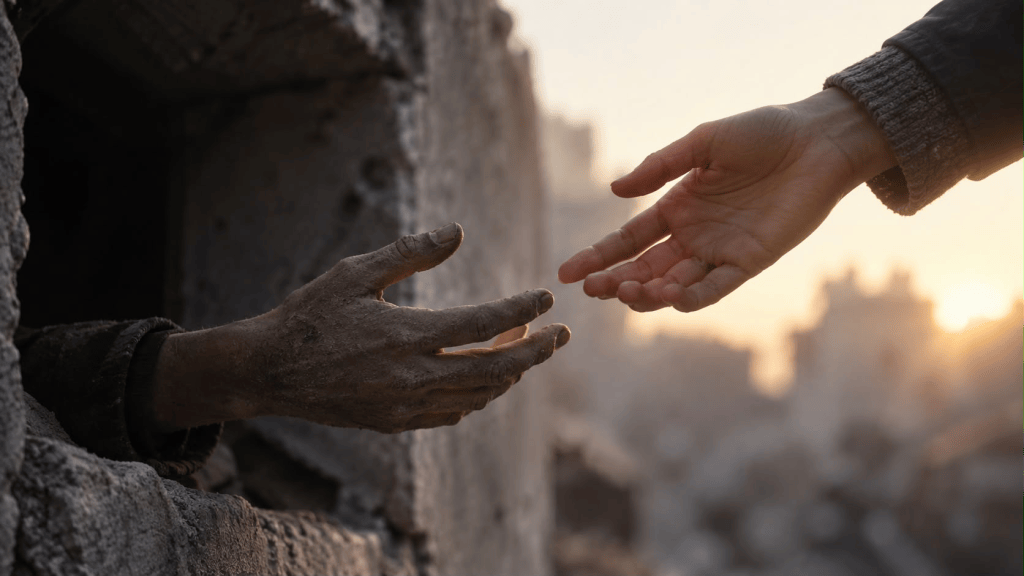
I keep seeing, in my mind, a hand coming out from under rubble.
One person may walk past because they do not want to see. Another may stop and feel pity but have no idea what to do. Someone else may try to pull the person free and discover that they cannot. Then another person is needed – maybe several. Someone who knows what to do. Someone with equipment, or medical knowledge, or access I do not have.
It seems obvious when you put it like that, but perhaps we forget it. We are not enough on our own. And sometimes the first useful thing we can do is admit that.
There is a difference between saying I cannot solve this and saying there is nothing I can do. The first may be true. The second may need another look.
That difference is what sent me back, a few days later, to two old speeches I had not listened to in years.
⸻
I listened again to Martin Luther King Jr. speaking to young students in Philadelphia in What Is Your Life’s Blueprint? He took those young people seriously – told them their lives had worth, that they should develop what was inside them and pursue excellence. He spoke about the dignity of ordinary work: if you sweep streets, sweep them well. A street sweeper matters. A cleaner matters. A child matters before becoming any of those things.
But listening again, I heard something I had not fully heard before. Before somebody can become a street sweeper, they must first be given the chance to grow up. There has to be food. Some safety. A street. A tomorrow. That is where the speech changed for me, because not everybody gets even that.
Some children are asked what they want to become. Others are trying to survive the night. Some are told to dream. Others are being pulled from rubble.
That is not easy to hold in the same mind. And yet it is the same world. There are still children laughing. People still sit together over coffee. A tree is planted. A person sits quietly beside a hospital bed. At the same time, somewhere else, a parent may be looking for a child beneath broken concrete.
The beauty is real. So is the cruelty. I do not know how to make those two things fit neatly together.
Perhaps they do not. Perhaps that is exactly why the hand under the rubble cannot be answered with a speech about potential alone. Potential means little to a child who is not given the chance to reach tomorrow.
⸻
The day after King was killed, Robert F. Kennedy spoke about the mindless menace of violence. He did not speak only of bullets and assassination. He understood violence could also be slower – found in deprivation, humiliation, the denial of dignity, and in indifference.
He brought everything back to people. Human beings who are loved. Human beings who are needed. Someone waits for them. Someone misses them.
That sounds simple. Perhaps it needs to be, because political language can make people disappear very quickly – populations, casualties, sides, numbers. And somewhere inside those words there is still a child, a mother, a father, a person who expected to be somewhere next week.
That is why some of the images from Gaza are so difficult to look at, and perhaps why some of them should not be looked away from too quickly. Not because suffering should become spectacle. It should not. But because abstraction makes suffering easier to tolerate, and the hand under the rubble belongs to somebody with a name.
When a child dies in war, we do not only lose the child as he or she was in that moment. We lose everything that might still have happened – the friendships, the work, the ordinary days, the laughter. We do not know what that child would have become, and that is not really the point. Their life did not need to become remarkable in order to matter. It already mattered.
That is one of the things I find hardest about violence. It destroys not only what is there. It destroys what might have been.
⸻
And yet I do not want cruelty to become the whole story either. Some people carry the wounds of Gaza in their hearts and souls because they have endured the violence of war into their very bones. And some of those same people still refuse to let the evil done by those in power blind them to the goodness that remains in ordinary people.
That matters to me, because ordinary people still help one another. They carry the wounded, share food, search for people, treat, translate, drive, dig, sit beside somebody who is afraid, make calls, wait, try – not because they think they can fix everything, but because there is another human being in front of them.
They are, in their own way, the hands that reach back.
⸻
I think of those hands again when I read about a young doctor who is deafblind. What stayed with me was not simply that she had persisted. It was that several things had to come together: ability, determination, opportunity, people willing to make room, and then her own willingness to make the best of it when the chance came.
Somewhere along the way, other hands had helped keep that opportunity open.
A label may describe something real, but it should never be allowed to become the whole story of a person. That is true of disability, age, poverty, illness, trauma. A label may tell us something. It rarely tells us everything.
That brings me back to the child Celeste was trying to help.
There is a danger in stories about determination if they leave us thinking that people only need to try harder. They do not. Willpower matters, talent matters, courage matters – but people also need opportunity. A child may need food before encouragement. A patient may need a border to open before treatment. And sometimes somebody needs another person to say: I cannot do this myself, but perhaps I know someone who can help.
I could not help Celeste in the way I wanted to. I could not reach that child from Australia and change what was happening. But perhaps the responsibility is still to ask whether there is one more call, one more introduction, one more person closer to the problem. There may still come a point where nothing more can be done, and that too has to be accepted honestly. There are things we cannot fix. There are people we cannot save. There are doors we cannot open.
But I do not want to arrive at that conclusion too quickly.
⸻
I will soon be travelling to South Africa, and these thoughts will probably travel with me. There will be conversations, old relationships and new ones, moments of memory. I do not want to force meaning onto any of them. Not every encounter needs to produce something, and not every relationship needs an outcome.
But I do want to remain alert to the possibility that one conversation may help somebody else, or one practical obstacle may become a little smaller.
If that happens, perhaps the question is simply: what is the next faithful thing?
⸻
I do not know how to repair a world in which one child is laughing in sunlight while another is under rubble. I do not know how to reconcile the beauty and the cruelty that exist at the same time. I do know that both children matter, that people are more than the labels placed on them, and that compassion remains incomplete if it never looks for a way to act.
I still see that hand coming out from under the rubble. I still do not know whose hands were needed, or whether they came in time.
Celeste asked a simple question: can anyone help? I still do not know what happened to that child. Perhaps that is why the question has stayed with me – not only over Gaza, but over this world.
Perhaps we reach anyway.
And if our hands are not enough, we look for others.

