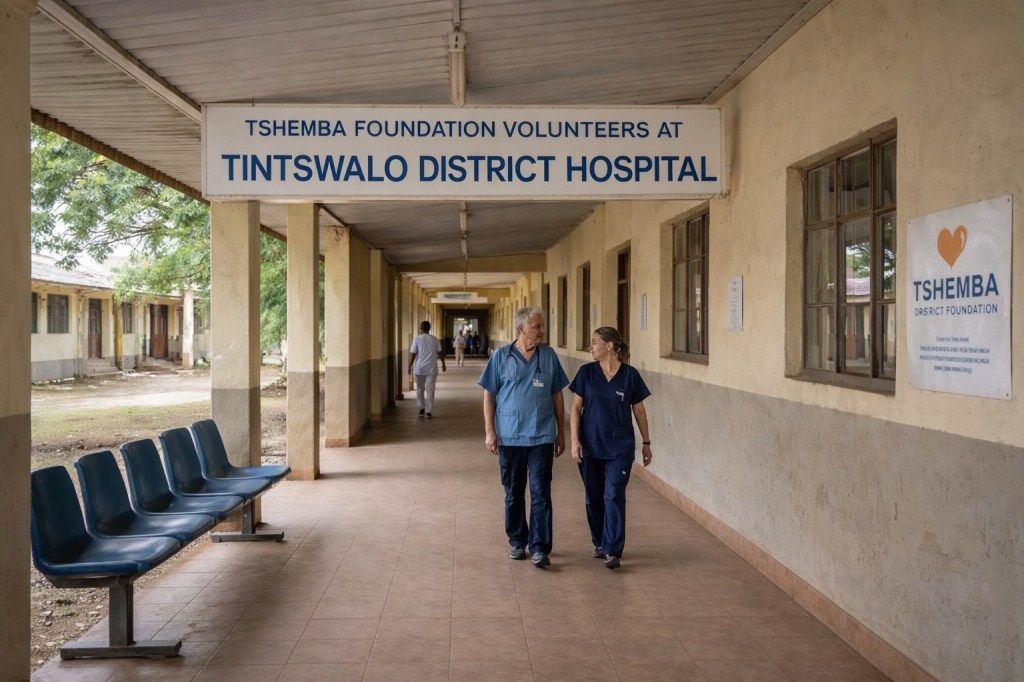
Illustrative image created using AI. No real patients or staff depicted.-
—
On founding, stewardship, and the quiet leadership that allows good missions to endure
by Paul Alexander Wolf
Internal cover note
This essay is offered as a foundational narrative reflecting the values and posture that shaped Tshemba from its beginning. It is written by a former volunteer (2023) who holds no current or future role in the organisation.
—-
Some forms of leadership announce themselves loudly.
They arrive with statements, strategy decks, and certainty.
Others reveal themselves over time.
Neil Tabatznik belongs to the second kind.
He is widely known for his work in film, media, and philanthropy. A barrister by training, an executive producer by profession, and a builder of institutions across continents. Yet Tshemba did not emerge from a boardroom or a strategic exercise. It emerged from something far simpler, and far rarer – attention.
Everything begins with attention. It begins with the willingness to see clearly.
In 2014, while spending time in the Hoedspruit region of northeastern South Africa, a clear reality presented itself. The area combined striking natural beauty and deep community resilience with a persistent gap in access to skilled healthcare in rural settings where need was constant and options were limited. Public health structures existed and were functioning under pressure, yet capacity remained stretched. What was evident was not the absence of systems, but the distance between clinical need and available support.
Tshemba emerged as a response to that reality – not to replace what was already there, but to strengthen it.
Together with fellow alumnus Godfrey Phillips, Neil founded the Tshemba Foundation with a deliberately restrained intent. The aim was not to build parallel systems, nor to assume ownership of care, but to work alongside existing public services in ways that supported continuity and capacity over time.
That distinction matters more than it might first appear.
From the outset, Tshemba’s model was intentionally modest in its design. Volunteers would work within South Africa’s public health system, under local authority and leadership, not outside it. Skilled clinicians from around the world would come for defined periods, support local teams, share experience, and then leave – quietly.
The work was never about control. It was about contribution.
Implicit in this approach was an understanding that rural healthcare does not need saviours. It needs steadiness, patience, and respect for what already exists.
Over time, Tshemba established a Volunteer Centre at Moditlo Private Game Reserve and developed formal partnerships with regional health authorities. Volunteers were placed at institutions such as Tintswalo District Hospital and surrounding clinics, complementing local capacity rather than displacing it. Specialist services, teaching sessions, and targeted initiatives followed naturally from this framework, shaped by local priorities rather than external agendas.
What distinguished Tshemba was not scale alone, but posture.
In healthcare, posture often matters more than volume.
Less visible, but equally important, is where the daily weight of such a mission is carried. In organisations like Tshemba, the true backbone is formed by those who operate between vision and reality – coordinating volunteers, sustaining relationships, and holding continuity as organisations mature. These roles rarely attract attention, yet they determine whether a mission functions reliably in practice.
Their work is demanding and essential.
Any founder who builds something that endures eventually relies on such people, whether or not they are named. That Tshemba has continued through changing seasons is due not only to its founding vision, but to those who quietly carried its operational centre over time.
Tshemba’s work has also been shaped by individuals who provided clinical and ethical steadiness across years. Professor John Gear, in his role as Medical Advisor and Medical Director, brought medical credibility, sound judgment, and a moral compass grounded in decades of experience in rural and public health. Alongside him, the Board of Directors carried governance responsibility and strategic oversight through evolving conditions.
On the ground, operational teams and volunteers translated intent into practice – coordinating placements, sustaining partnerships, and showing up day after day in environments where reliability matters more than recognition. Together, these layers formed the human architecture that allowed the mission to function beyond vision alone.
Tshemba exists because one person chose to act, and because many others chose to carry that action forward. Neil Tabatznik’s founding role made the work possible. The people on the ground gave it life.
Neil did not attempt to manage medicine from afar. He invested, trusted experienced people on the ground, and allowed clinical and operational leadership to sit where it belonged. This was evident in how responsibility was delegated, how expertise was respected, and how continuity was prioritised over visibility.
Founders often struggle with the moment when a mission must grow beyond its original hands. Neil’s strength lay in recognising that the role of a founder is not to remain central forever, but to create something capable of carrying purpose forward without constant direction from its origin.
That does not mean stepping away from responsibility.
It means holding the long view, even when the present is complex.
Anyone who has worked in or alongside rural health systems knows how fragile they can be. Funding shifts. Staff change. Pressure accumulates. The work is relentless, and the margins are thin. In such environments, the temptation is to narrow focus, to protect territory, to retreat inward.
Neil’s contribution has been to keep Tshemba oriented outward – toward service, partnership, and continuity – even as circumstances evolve.
This is not intended as a commemorative account, nor as a definitive institutional history. It is a description of posture – the assumptions about service, partnership, and restraint that shaped Tshemba from its beginning, and that will matter long after individual names and moments fade from view.
As Tshemba looks toward 2026, that founding posture matters more than ever.
Good missions endure when they remember why they were formed. When leadership remains larger than circumstance. When stewardship matters more than control. And when those who serve are trusted to work with integrity, humility, and respect for the systems they enter.
The future of Tshemba will not be written by any single person.
Nor should it.
It will be carried forward by volunteers, clinicians, nurses, educators, administrators, and community partners who understand that service is strongest when it is shared.
Neil Tabatznik’s legacy is not only that Tshemba exists.
It is that Tshemba was built in a way that allows it to continue – thoughtfully, quietly, and with purpose – long after the founding moment has passed.
That is the long view of service.
 We dream of things that never were and say: "Why not?"