No child should have to cross a border to find oxygen, safety, or hope.
If medicine can move, humanity can still win.
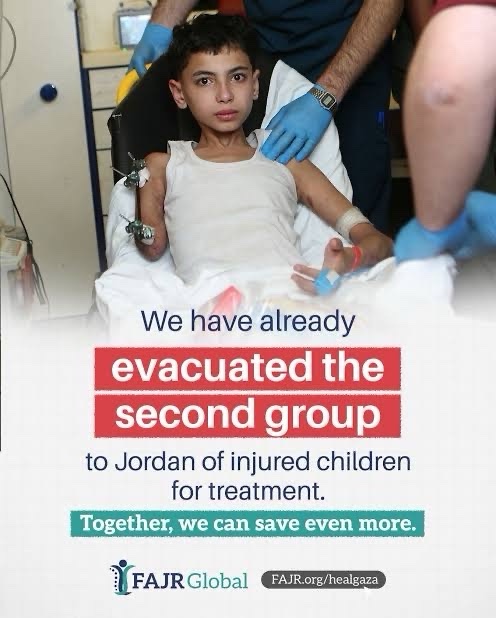
(Photo: FAJR Global – shared with respect and gratitude to those saving lives.)
——-
I write to you today not as a politician, not as a diplomat, but as a doctor. I have not been to Gaza in the weeks of this most terrible crisis. I am not an eyewitness to every bedside there. But I am a clinician who has seen what happens when oxygen fails, when fuel runs out, when medicine is delayed and paperwork outwaits a pulse. I speak from that knowledge – from the clinical truth that time and supplies are often the difference between life and death – and from the conviction that where policy predictably kills, silence becomes complicity.
I offer these words for the doctors who stayed when they could have left, for the nurses who worked without salary or sleep or safety, for the children who never reached the border – whose names were still on evacuation lists when their hearts stopped. I offer them for every parent, in Gaza, in Israel, anywhere, who has buried a child and still refuses to hate. I speak as a clinician who refuses to look away.
There are nights in Gaza when the world thinks the danger has paused because the headlines have moved on. The shelling may stop. The jets may hold their fire. But inside hospital corridors the dying does not stop. Incubators go silent when generators run out of fuel. Wounds that could have been cleaned become infected without antiseptics. IV lines are run with what water can be boiled. Children with cancer wait on lists for permission to leave while tumors progress and bones break and parents count the hours. Those are not the images of a natural disaster – they are the predictable consequences of restrictions on food, fuel, medicine, and movement. That is not peace – it is a slower kind of violence.
As a doctor I must be blunt: whoever controls the gates controls who lives and who dies. Gaza has no airport, no functioning seaport. Its land crossings, its airspace, its fuel and its supplies are controlled entirely or indirectly by the state and military that surround it. Since Israeli forces assumed operational control of the Palestinian side of the Rafah crossing in 2024, every ambulance that attempts to cross, every oxygen cylinder that seeks passage, every child who needs chemotherapy has required permission. Requests go in – pending – unanswered – refused. Requests become waiting lists, waiting lists become funerals. This is not an abstraction. It is clinical causality.
We must also be precise with our words because truth matters. Amnesty International, after legal and forensic investigation, has concluded that the actions of Israeli authorities in Gaza amount to genocide under international law – that the cumulative effect of siege, starvation, forced displacement, and the denial of medical care meet the legal elements they have documented. That is Amnesty’s legal and evidentiary judgment. It is not rhetorical hyperbole. It is a finding by a respected international human-rights organisation that demands attention, investigation, and accountability. To read that conclusion and to remain neutral is not to practice prudence – it is to abandon duty.
Many will want to pause and say: be careful – history cannot be reduced to slogans. They are right. The Holocaust was a singular, industrialised horror of a kind we must not trivialise. Yet history also teaches: when language dehumanises a people, when food and medicine are used as instruments of war, when hospitals become battlefields and journalists and medics are silenced, patterns recur. These are not perfect analogies to the past; they are warnings – whispers from history that say: do not let systems of control become systems of death. Recognition of pattern is not an accusation of an entire people – it is an insistence that leaders and policies be named and judged.
Secrecy corrodes moral perception. President John F. Kennedy once called secrecy in public life repugnant; that word still fits when the suffering of civilians is hidden behind closed gates, when aid convoys wait while supplies spoil at the border, when journalists are killed or detained for reporting from wards and ambulances. Secrecy and control of information are not neutral instruments of security when they have the predictable result of starving hospitals of the fuel that powers life-saving equipment. Secrecy, in that context, is a moral failing.
Let me tell you what the humanitarian record shows – not as an exercise in outrage, but as a clinician describing what destroys bodies and hopes. WHO, UNICEF, MSF, UN OCHA, and medical groups on the ground have documented children dying of dehydration and malnutrition even during ceasefires, mothers diluting powdered milk with unsafe water, surgeons performing amputations without adequate anaesthesia, premature infants dying when oxygen ceases, and medical staff detained or made to disappear during hospital raids. These are documented facts. When facts converge on the same conclusion – that access is blocked and that people are dying as a result – law and conscience require a response.
Conscience and law are partners here. International humanitarian law forbids starvation of civilians as a method of warfare. It protects medical personnel and facilities. It obliges parties to allow and facilitate rapid and unimpeded passage of humanitarian relief. When independent organisations, after investigation, say that those legal protections have been breached in ways amounting to the gravest crimes, those allegations must be investigated thoroughly, preserved with evidence, and prosecuted when warranted. Justice is not vengeance. It is responsibility. Nuremberg taught the world that orders and state policy do not absolve moral agency. If competent, impartial tribunals find individuals criminally responsible, the rule of law must be invoked – not in hatred, but in duty.
We must also speak frankly about sexual and gender-based violence. Independent UN experts and human-rights monitors have gathered credible testimony of sexual violence in detention, during raids, and in contexts of forced displacement. These are not incidental atrocities that can be dismissed as fog-of-war collateral damage. They are assaults on bodily dignity and must be investigated, survivors protected, and perpetrators held accountable. Naming such crimes is not scandal – it is respect for those who have suffered and a step toward prevention.
So what should we do – not in slogans but in clear steps? First, open the gates. Approve medical evacuations without delay. Allow fuel into hospitals and water into desalination plants. Permit food and medicine at scale. Success should be measured not by press conferences but by lives saved. Second, protect medical neutrality. Hospitals, clinics, ambulances, and medics are not legitimate military targets. Release detained medical staff unless there are lawful charges and fair trials. Third, preserve evidence and support independent investigations. Protect witnesses and fund impartial judicial processes that can lead to accountability. Fourth, apply pressure without punishing civilians. Condition assistance and diplomatic ties on compliance with humanitarian law; target sanctions at those credibly responsible for criminal decisions – not at the families who need bread. Fifth, begin any political horizon with safety first. Siege is not security. Security that begins with civilian protection – water, food, medicine, safe passage – is the only sustainable foundation for peace.
I know some will say this is simplistic. I know geopolitics is complex. But medicine is simple: a human body requires water, nutrition, warmth, oxygen, and care. When those essentials are denied by policy, medicine does not invent causes; it records consequences. To argue over geopolitical nuance while children die at hospital bedsides is to make moral calculus a luxury that the dying cannot afford.
Let me be plain about language. I condemn actions, not peoples. I condemn policies and the decisions of those in command that have predictable lethal outcomes. I condemn any rhetoric that seeks to dehumanise communities. To be clear – this is not a statement against Jewish people, Judaism, or Israelis as a whole. It is a statement against policies and decisions that weaponise civilian suffering. If courts later adjudicate individual responsibility – and that is how just systems must operate – those individuals should be judged and held to account under the rule of law.
But condemnation alone is insufficient. We must act. Clinicians, humanitarian organisations, diplomats, and citizens must refuse to be neutral in the face of preventable death. We must demand transparency, safeguard evidence, and insist that aid be delivered in sufficient volumes and with the protections necessary to make it effective. We must demand that states and institutions use leverage to keep hospitals running and to enable evacuations for the sick and wounded. We must demand that no form of collective punishment be tolerated in the name of security.
There is a moral grammar that belongs to medicine and to faiths and to civic life alike: to save one life is to save a world. That is not sentimentalism – it is a moral axiom. It undergirds ancient religious teachings and modern human-rights law alike. It is why doctors cross borders, why nurses volunteer, why aid workers risk their lives. It is why we must insist that the preservation of life is the first metric of any political strategy.
History whispers to us. It whispers when the mechanisms of harm begin to resemble earlier patterns of collective destruction – not to assert identity-based equivalence, but to warn us that systems of dehumanisation historically spread until someone says stop. The whisper should be unbearable now. It asks: who did we choose to be when faced with preventable suffering? Will we be the generation that sat with hands folded and diplomatic niceties while a population was ground down by siege, or will we be the generation that opened gates, that protected hospitals, that insisted on the immediate application of law to stop the killing?
This is not an easy moral position, and it is not an invitation to hatred. It is an insistence that our civilisation be measured by how we treat the most vulnerable. If “Never Again” is to mean anything, it must mean never again for anyone. That includes those who now live in Gaza.
I do not pretend that words alone will change policy. But words are necessary because words shape will, and will shapes action. Speak plainly in public and in private. Support organisations doing the work on the ground. Pressure your representatives to demand unimpeded aid and safe passage. Fund independent investigations and protect their witnesses. Tell those in power that their credibility depends on how they protect civilians, not on how they excuse their failure.
I speak as a doctor who wants no more children to die because paperwork waited and fuel did not come. I speak as a citizen who believes law and conscience must meet in action. I speak as someone who knows the quiet of a hospital when the monitors stop – and I refuse to let that quiet become the permanent condition of a people.
Open the gates. Protect the medics. Preserve the evidence. Hold leaders accountable if the law requires it. And in all this, do not let hatred take the place of justice. Let our response be measured, legal, and humane. Let it be fierce enough to demand change and gentle enough to preserve human dignity.
If we answer this whisper from history with courage – with law, with charity, with the steady refusal to be indifferent – then we will have done what conscience asks of us. If we fail, history will record that we listened and did not act. I choose to act. I invite you to act with me.
Paul Alexander Wolf
 We dream of things that never were and say: "Why not?"