by Dr Paul Alexander Wolf MBBS FRACGP JCPTGP DFFP
Physician, humanitarian, and writer
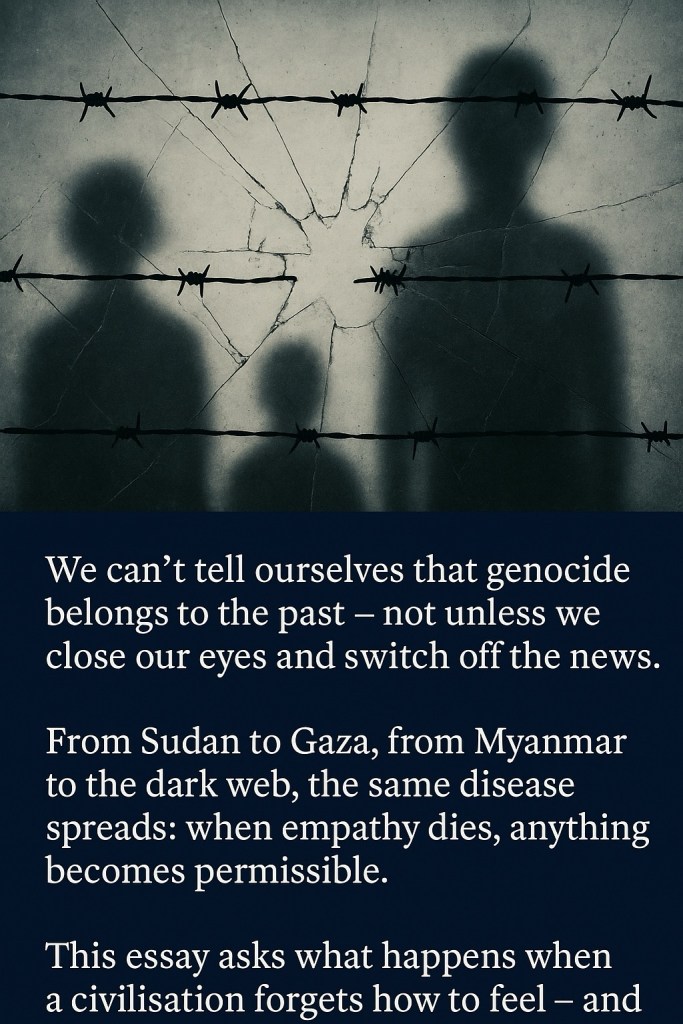
The picture above represents silhouettes behind barbed wire and broken glass – a quiet reminder of how easily freedom fractures when empathy fails. Each outline could be anyone, anywhere. The image is not from one war, but from all of them: the moment humanity forgets how to feel.
——
🌍 Companion Introduction – Two Addresses, One Conversation
These two pieces were always meant to belong together.
First address – When the World Forgets How to Feel
This is the diagnosis: a reflection on what happens when empathy collapses, when language dehumanises, and when we begin to walk past suffering as though it is none of our concern.
Second address – It’s Better to Give – Not Only What You Have, But Who You Are
This is the remedy: a quiet answer to the question, “What can we do?” It is about a kind of generosity that does not fix the world, but keeps the human heart from going numb.
One names the wound.
The other shows how not to let it spread inside us.
Together, they form a single conversation –
the loss of feeling, and the choice to keep feeling anyway.

——
We can’t tell ourselves that genocide belongs to the past, not unless we close our eyes and switch off the news.
From the burning villages of Sudan to the ruined camps of the Rohingya, from a Yazidi girl standing barefoot in the rubble of Sinjar to a nurse in El-Fasher still dressing wounds by torchlight, the old ghosts are walking again.
They move quietly through our headlines, disguised as “conflict,” “instability,” “security operations.”
Each generation says Never again – and yet again keeps finding a way.
I. The Descent
The roots of atrocity are not military, they are psychological.
They begin with fear, spread through language, and harden into obedience.
No genocide starts with a gun. It starts with a story: they are dangerous; they are impure; they are the reason you suffer.
At first, the whispers seem harmless. Then they gather rhythm. Then they roar.
And when the first body falls, the loudest sound in the world is the silence of bystanders.
Historians call it dehumanisation. Psychiatrists call it moral disengagement.
I keep returning to a photograph I wish I had never seen – a mother holding her child in a ditch, their shadows framed by men with guns.
The soldiers – or whatever they have become – might be parents too. That thought is what breaks me most.
What brings a person so low that the instinct to protect becomes the instinct to destroy?
I see not only the victims but the executioners – hollowed by fear, by obedience, by the death of empathy long before the trigger was pulled.
We call it atrocity; yet beneath it lies something more ordinary, more terrifying: the slow unravelling of what makes us human.
But those are just names for the same collapse: the moment empathy dies.
In every century the infection finds a host.
In Armenia, fear.
At Babi Yar, discipline.
In Rwanda, a radio that called human beings “cockroaches.”
In Srebrenica, men who once played football with the same boys they later executed.
When humanity forgets how to feel, calculation replaces conscience.
And what begins as propaganda ends as a pit.
II. The Modern Pathology
Today the tools have changed, but the sickness has not.
A lie no longer needs a loudspeaker – it only needs a signal boost.
Algorithms feed our fear until hatred feels like belonging.
The contagion is digital now – faster, invisible, addictive.
It turns citizens into spectators and spectators into accomplices.
What once took years of propaganda can now happen in a weekend.
A Yazidi girl told a reporter, “They took away our names first.”
She did not mean only the men who enslaved her; she meant the world that scrolled past.
A Sudanese nurse whispered through a crackling line, “We are still here, even when the world looks away.”
That sentence should shame us all – because looking away has become our reflex.
III. The Cracking Ice
Every civilisation rests on an emotional foundation – empathy, trust, restraint.
When those crack, the structure still looks solid, right until it collapses.
Look around.
We amuse ourselves with humiliation, mistake cruelty for humour, confuse cynicism with wisdom.
We scroll through suffering as if it were content.
We see it in the dark web where children are traded like merchandise.
We see it in the rage industries that turn outrage into income.
We see it in the exhaustion of ordinary people who flinch at every headline and choose numbness over care.
Psychiatrists call it compassion fatigue – the burnout of the soul.
But it is also a kind of surrender.
Because when we stop feeling, someone else starts deciding who counts as human.
IV. The Pattern of Warning
Atrocities are not earthquakes; they are slow diseases.
They declare themselves long before they detonate.
We can track their symptoms – propaganda, impunity, economic shock, militia build-up, population sorting.
Those who work in humanitarian response use a simple matrix – five domains that, when they flare together, warn that a nation is entering danger.
Today five names flash red: Sudan, Myanmar, Congo, Haiti, Ethiopia.
Different histories, same rhythm – fear, isolation, silence.
And beyond the frontlines, the moral erosion continues:
disinformation that corrodes trust, governments that trade truth for loyalty, mobs that mistake violence for virtue.
V. The Wider Mirror
Genocide is not confined to broken states.
It is the mirror of what any society can become when conscience collapses.
The same circuitry that justifies mass killing can justify child abuse, trafficking, exploitation – any act that turns a person into a thing.
The investigation you may have seen into the dark web – the images of children hidden behind locked doors and encrypted screens – that is not a separate evil.
It is the same disease in a new disguise: the belief that empathy is optional, that anonymity excuses cruelty, that another’s suffering is none of our business.
A culture that tolerates the sale of innocence online is a culture rehearsing for larger crimes offline.
When we normalise degradation, we lay the psychological groundwork for atrocity.
VI. The Psychology of Contagion
How does the infection spread?
Through fear, imitation, and indifference.
Fear narrows the mind – cruelty begins to feel like safety.
Imitation gives permission – if others are silent, I can be too.
Indifference completes the cycle – it tells the victim they are invisible.
That is how ordinary people become administrators of horror.
Not because they are evil, but because they are empty – emptied of empathy, emptied of doubt.
In medicine we monitor vital signs to keep a patient alive.
Humanity has its vital signs too: kindness, curiosity, the capacity to blush.
When those flatten, civilisation goes into arrest.
VII. The State of Humanity
Our global vital signs are unstable.
Conflicts multiply faster than compassion.
Technology outpaces ethics.
Children grow fluent in irony but illiterate in empathy.
Governments treat human rights as negotiable.
International law has become a suggestion.
And people of good will retreat into fatigue – “it’s too much,” they say.
But history does not forgive fatigue; it only records its consequences.
We are omnipresent now – we can witness everything, and yet we are moved by almost nothing.
If that does not change, the next century will not be remembered for its innovation but for its indifference.
VIII. The Counterforce
And yet, there is still light.
There always is.
A Yazidi girl, once enslaved, returns to Sinjar and builds a school.
A Sudanese nurse keeps her patients alive with saline mixed by hand.
A journalist keeps filming when the soldiers shout, “Turn it off.”
A teacher in a refugee camp refuses to teach hate.
These are not saints.
They are the antibodies of civilisation – proof that the conscience still fights back.
Our task is to make their courage contagious.
To design technology that amplifies truth instead of rage.
To build institutions that reward empathy, not cruelty.
To choose leaders who protect the vulnerable before they protect themselves.
Governments are not abstractions; they are extensions of our collective psychology.
If we are numb, they will be blind.
If we are courageous, they will act.
IX. Re-learning to Feel
Rebuilding empathy is not sentimental; it is strategic.
It is the only vaccine we have against the return of barbarism.
That means teaching children not only to code but to care.
Teaching history not as a list of wars, but as a map of moral choices.
Funding not just weapons, but witnesses – journalists, doctors, social workers, the people who hold the line between chaos and compassion.
And it means looking at every refugee, every prisoner, every victim of abuse and remembering: the line between them and us is thinner than we think.
Empathy is not a luxury of peace; it is the condition of it.
X. The Call
There comes a time when silence becomes its own crime.
That time is always sooner than we think.
The world rarely collapses in a single day; it erodes – word by word, click by click, indifference by indifference.
We are the generation that must decide whether empathy remains the organising principle of civilisation or becomes a relic of history.
We can choose cynicism – the easy irony that nothing matters.
Or we can choose conscience – the hard work of feeling, even when it hurts.
Every doctor knows that a heart can stop suddenly, but it also knows how to restart it.
What revives a civilisation is the same: pressure, rhythm, breath.
Pressure from truth.
Rhythm from courage.
Breath from compassion.
XI. The Closing Cadence
When the world forgets how to feel, everything becomes permissible.
But when we remember – even for a moment – the impossible becomes possible again: reconciliation, repair, redemption.
So let us be the ones who remember.
Let us be the witnesses who refuse to look away, the citizens who protect rather than exploit, the leaders who measure success by the safety of the smallest child.
Because the moral arc of the universe does not bend by itself; it bends under the weight of hands that still care.
Every generation inherits the same question: will we defend our humanity, or delegate it?
We can close our eyes, switch off the news, and tell ourselves that genocide, cruelty, and exploitation belong to the past.
Or we can open them – wide – and act before indifference becomes our legacy.
If we do, history may yet say that in a time of numbness, a few people remembered how to feel –
and by remembering, kept the world alive.
Afterword – The Mirror Closer to Home
Some will read this and think of distant wars, faraway tyrannies.
But the mirror is closer than we like to admit.
In America – still the world’s most powerful democracy – the same emotional fractures that precede decline are widening: the distrust, the tribalism, the language of contempt.
People no longer see opponents; they see enemies.
Nearly half of each political camp now believes the other is a threat to the nation’s survival.
That is not debate; it is the pre-psychology of violence.
Add to this a civilian arsenal larger than the country’s population – over 390 million guns, including more than 20 million rifles patterned on military designs – and you have a society where fear and firepower coexist in every neighbourhood.
A single rumour, a single lie, can travel faster than reason and ignite more than rhetoric.
The warning signs are not destiny, but they are familiar:
rhetoric that dehumanises, militias that intimidate, leaders who treat truth as negotiable.
These are not yet atrocities; they are the conditions in which empathy dies.
The United States still has guardrails – courts, journalists, civic courage – but they are only as strong as the citizens who believe in them.
If language continues to divide and violence continues to seduce, the line between unrest and collapse could narrow with terrifying speed.
The danger now is not that America will fall overnight, but that it will forget how to feel together – that it will lose the capacity to see suffering as shared.
And if that happens, the disease that has ruined nations abroad will find a new host at home.
So the work of remembering is not just global; it is local, intimate, American too.
It begins wherever a citizen chooses empathy over fury, truth over tribe, courage over convenience.
That is how democracies survive – one conscience at a time.
Dr Paul Alexander Wolf MBBS FRACGP JCPTGP DFFP
Physician, humanitarian, and writer
———
This address is the diagnosis – what happens when empathy collapses and conscience falls silent. Its companion, the next one – It’s Better to Give – is the remedy: how compassion lives again through presence, courage, and giving.
 We dream of things that never were and say: "Why not?"