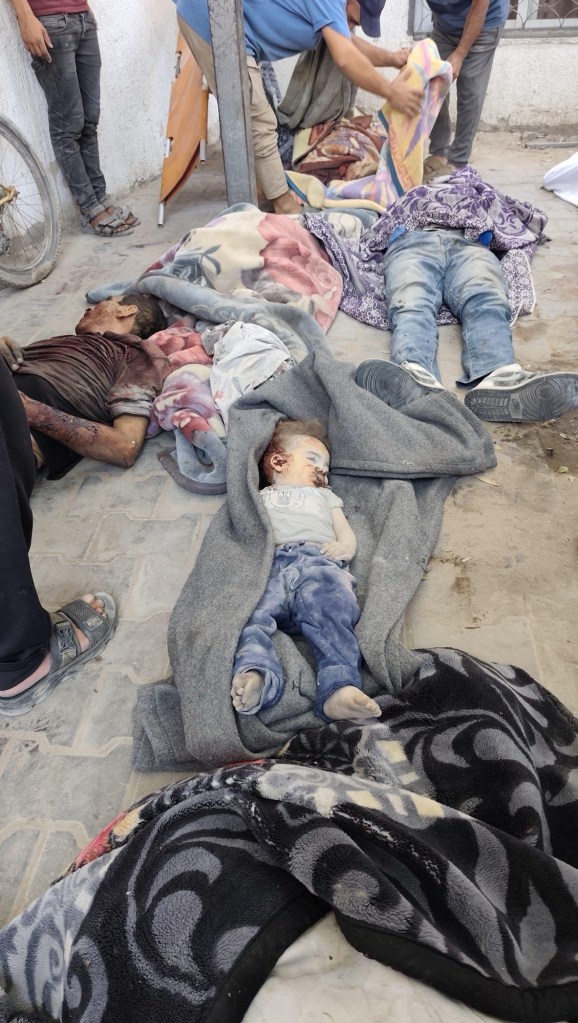
Gaza: an ongoing death trap of collective responsibility – a catastrophe at holocaust proportions, where the innocent bear the unbearable weight of history repeating itself.
——-
A reflection on mortality, meaning, and the courage of those who keep caring when the world collapses.
Context Update – October 28 2025
As of this evening, Israel’s Prime Minister Benjamin Netanyahu ordered “powerful, immediate” strikes across Gaza after alleging that Hamas violated the ceasefire.
Reports from Al Jazeera, Reuters, and The Guardian confirm multiple explosions near Gaza City and Khan Younis, including areas close to hospitals.
At least nine people have been killed and more than fifteen injured so far, with fears of wider escalation.
For doctors and civilians already working at their limits, this return to bombardment shatters a fragile calm that had barely begun to restore hope.
It turns the themes of this reflection – control, suffering, and the meaning of care – into present tense once again, reminding us that reflection is never separate from reality.
The moment when power ends
There are moments when life strips us of control.
For some, it happens in a hospital room. For others, it happens in a city under fire.
And in those moments, all the noise of ambition, fear, and pride falls away – leaving only what is true.
Steve Jobs once stood as a symbol of human control — the man who bent technology to his will, who believed design and precision could outsmart chaos.
Yet at fifty-six, lying in a hospital bed, he discovered that no brilliance or wealth could change the truth written into every human body.
The cancer growing inside him did not care about success or vision. It obeyed only the law that all things must pass.
Across the world, in Gaza’s shattered hospitals, other kinds of people face that same truth — not in their own bodies, but in the bodies of those they try to save.
The doctors who serve there work through dust and darkness, where the walls shake and the cries of children fill the air.
They live in a world of broken glass and shadow, yet they too confront the limits of control every single day.
The quiet transformation
For Jobs, power ended with his body.
For Gaza’s doctors, power ends outside it.
They stand in a place where medicine is not enough – where the wound is not just physical but moral, collective.
There are days when they can save a child, and days when they cannot.
And yet they return, because compassion itself has become their act of defiance.
Both stories reveal the same paradox: that control is a story we tell ourselves.
When that story ends, what remains is what’s real – presence, tenderness, courage.
The human shift
When Jobs was young, he believed perfection could save him – that if he could make something beautiful enough, it might hold back the chaos.
But illness humbled him. He became softer. He cried in meetings when something moved him. He told his wife every day that she was beautiful.
His last words – “Oh wow. Oh wow. Oh wow.” – were not fear, but wonder.
That same wonder is lived daily in Gaza, though it has no time for words.
When a doctor holds a fading heartbeat, or steadies a colleague’s trembling hands, they are staring into the same mystery:
the awareness that love, even surrounded by death, is still possible.
What remains
There comes a point when we all face our own Gaza, our own diagnosis – when something larger than us reminds us how fragile we are.
And in that moment, we see clearly: the things we built, the titles we earned, the wealth we gathered – none of them can hold our hand when the light begins to fade.
What can?
The voice of someone we love.
The memory of kindness given and received.
The simple fact that we tried to make something better – even when it hurt.
The worth of a life
Steve Jobs once said that remembering he would die helped him live more honestly – it freed him from the fear of failure.
The doctors in Gaza show something even deeper: remembering that others might die compels them to live more fully, more generously.
Both truths point in the same direction – that the worth of life is not in its length or comfort, but in its connection.
We are here to care. To build what matters. To look into the face of suffering and still say, “I will not turn away.”
That is the quiet revolution of the heart – the one that outlasts innovation, borders, and even war.
The healers who carry the wound
But there is another truth that lingers behind both stories – the healers themselves.
Those who go, serve, and come home changed.
Some are doctors from Gaza; others have come from Australia, the UK, France, and beyond.
They flew into chaos for weeks or months, believing, as most of us do at the beginning, that skill and courage can mend everything.
But the truth they met was harder.
They returned carrying invisible fractures – not from bullets or disease, but from witnessing too much.
I think of one English doctor I once heard interviewed – the daughter of an orthopaedic surgeon, trained in France, who served in a violent corner of Africa.
She faced what no medical textbook could prepare her for: the sound of grief, the limits of saving.
When she returned to Europe, she could no longer operate; the war had followed her home.
She turned to psychiatry, dedicating her life to helping others with post-traumatic stress – the same wound, now seen from the inside.
In her story, and in the doctors of Gaza, and even in Jobs, I see a single truth:
that witnessing suffering changes us, and that the bravest thing we can do after it breaks us is not to forget – but to turn our pain into understanding.
The call
Maybe that’s what Steve Jobs saw when he whispered “Oh wow.”
Not heaven, not closure – but clarity.
Maybe he saw, for the first time, what those who serve in Gaza’s hospitals already live each day:
that life is not something we own, but something we share.
So when control fails, when the plans unravel, when the world feels like it’s breaking – let us remember this:
To be alive is already a miracle.
To love in the midst of pain is the highest form of success.
And to look at the world, even through tears, and still whisper “Oh wow” –
that is what makes life worth living.
Maybe the worth of life isn’t measured by how much we endure,
but by how much gentleness survives in us after we’ve endured it.
Paul Alexander Wolf
Paul Alexander Wolf is a doctor and humanitarian writer who has worked in both resource-rich and resource-limited settings. His reflections explore the meeting point between suffering, service, and the quiet strength of those who keep caring.
 We dream of things that never were and say: "Why not?"