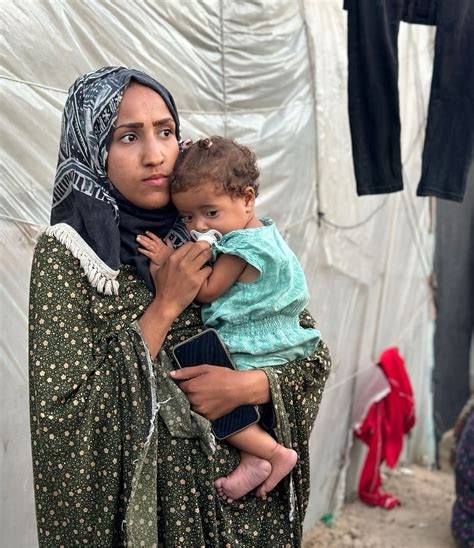
A Palestinian family in a refugee camp.
–
“Speak up for those who cannot speak for themselves,
for the rights of all who are destitute.”
- Proverbs 31:8
Khadija’s story is not unique, and yet it is. It is one of survival and quiet strength – a life shaped by borders, bombings, and bureaucracies, yet lived with faith, hope, and dignity. After nearly two decades in Australia, Khadija still carries Gaza within her – in her memories, in her voice, in the way she shields her children from the evening news. She remembers the explosion that took her nephew’s life – a boy of ten, who once traced football teams on the backs of schoolbooks and dreamed of one day becoming a pilot. He was gone in an instant. No warning, no mercy.
She fled Gaza with her children during a time of intense bombardment, her youngest still clinging to her breast. Her home – shattered. Her clinic – destroyed. Her neighbourhood – turned to dust. They crossed borders, deserts, waiting rooms. They landed in Australia, not with luggage, but with grief. She believed, like so many do, that here her children could finally be safe. And for a time, they were. But safety, she has learned, is not the same as peace.
Peace needs permanence. It needs belonging. It needs a place to call home – not just for now, but for always.
Today, Khadija lives in limbo. She has been on a temporary visa for years. Her children go to school, speak English like locals, play footy. But every few years, their lives are thrown into uncertainty – another visa application, another delay, another letter from immigration reminding them how conditional their welcome really is. For Khadija, it is a quiet cruelty – the feeling that after all they have endured, they are still not seen, not settled, not safe enough to stay.
This is not her story alone.
It is the story of a people denied permanence.
Amnesty International has documented how Gazan asylum seekers – even those fleeing verified war crimes – face consistent barriers in Australia’s immigration system. The United Nations has declared Gaza a humanitarian catastrophe. The images are seared into global conscience: children under rubble, newborns in tents, elders cradling photos of the dead. In this context, every delay in processing visas is not just paperwork – it is a failure of compassion. It is a failure of justice.
And the contrast could not be starker.
In May 2025, U.S. President Donald Trump revived the long-discredited claim of a “white genocide” in South Africa – a narrative rejected by human rights experts, local leaders, and data. Still, his administration swiftly offered fast-tracked visas to white South African farmers, calling it a moral emergency. The South African government, led by President Cyril Ramaphosa, pushed back. But the visas went ahead.
Meanwhile, Palestinians – for whom the word genocide is no longer theoretical but tragically real – are left in limbo.
Why are some cries heard and others silenced? Why do some bodies count more than others?
Australia, too, faces this test.
How can a nation built on the dreams of immigrants, a nation that speaks of “a fair go” and Christian decency, stand silent when Palestinian families beg not for charity but for permanence, for safety with dignity?
“Woe to those who make unjust laws,” the prophet Isaiah cries,
“To those who issue oppressive decrees…
Denying justice to the poor, and withholding rights from the oppressed.”
- Isaiah 10:1–2
This is not about pity.
It is about principle.
Let them stay.
Let the children stay.
Let their parents stay.
Let families stay together.
Let those who have suffered enough be welcomed, not suspended.
Let Australia offer not just shelter – but sanctuary.
Let the promises we make reflect the values we claim.
Let our borders not be gates of exclusion but doors of grace.
Let this nation show its soul – by refusing to look away.
🇦🇺Paul Alexander Wolf 🇦🇺
—>>>>
You can raise your voice today.
Join Amnesty International’s campaign to grant permanent protection to Gaza’s survivors.
Go to amnesty.org.au
Then search: “Let Them Stay”
Stand with those who have suffered enough. Let this be the moment we turn compassion into action.
 We dream of things that never were and say: "Why not?"