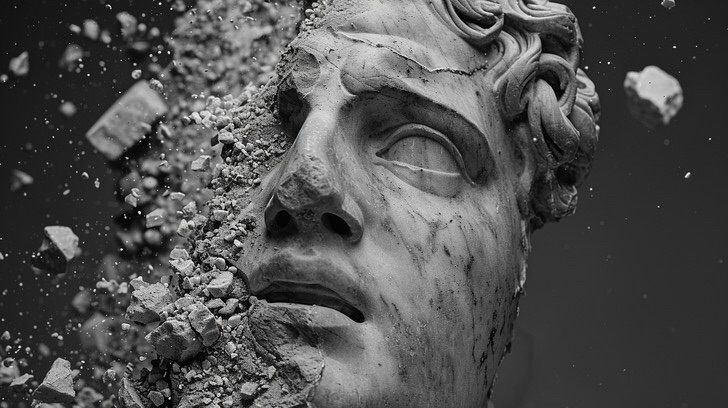
You can hear it in the waves, in the wind, in the silence after the storm.
The oceans are speaking – and they are not whispering.
This year, more than 84% of the world’s coral reefs are suffering from mass bleaching. The cause is no mystery. The waters are too warm. The planet is too hot. Last year was Earth’s hottest on record—and most of that excess heat has been poured into the oceans, pushing coral reefs—those ancient rainforests of the sea—beyond the very threshold of life.
The reefs are not merely casualties. They are the messengers of our time. They are the first sentinels in a greater catastrophe—signaling, screaming even, in a language we’ve long ignored. They are warning lights on the dashboard of the Earth. Blinking red. When corals bleach, they are not dead—yet. But they are suffocating. What we do next will determine whether they survive or vanish forever. This is not an abstract issue. It is a matter of life and death—our life and death.
We were meant to be the guardians of creation.
This calling is not merely environmental—it is an irrefutable moral imperative. The prophet Isaiah warned us of a time when the Earth itself would suffer because we broke faith, not just with God—but with life itself:
“The Earth lies polluted under its inhabitants; for they have transgressed laws, violated the statutes, broken the everlasting covenant.”
– Isaiah 24:5
We broke that covenant. We chose profit over principle. Convenience over consequence. Economic growth over ecological truth. And now? The seas are rising, the forests are burning, and the very air we breathe is thick with the scent of impending ruin.
But amidst the darkness, there is something that refuses to be extinguished – something older than politics, more primal than fear.
In human history, a healed femur in ancient times marked the dawn of civilization—because someone chose to stop, to stay, to help. And so too today, the broken bones of nature call us to action. Nature’s suffering, its cry for help, mirrors our own ability to choose compassion, to choose life. This is the threshold moment. The very definition of civilization itself hinges on our response.
Nature, too, is resilient – but this resilience is not an eternal guarantee.
When coral reefs bleach, they are gravely wounded – but not yet beyond hope. Some adapt. Some create new life in ways we do not yet fully understand. Just as our brains can reroute after trauma, so too does the Earth show signs of survival. This is not magic—it is life’s inherent will to persist, to adapt, to evolve. It is resilience born of necessity, forged in the fires of existential challenge.
But here is the truth we must face: even resilience has its limits. The time to act is now.
This is not a new crisis. Former US President Al Gore sounded the alarm decades ago. Scientists have issued warnings that have grown louder and more urgent with each passing year. And yet, political leaders – driven by short-term gains and personal power – have ignored these warnings. The former and (again) current U.S. President’s reckless disregard for climate action wasn’t just negligence – it was abdication of responsibility, a betrayal of future generations.
This is not just a scientific issue. It is a moral one. The climate crisis is a test of our humanity, a test we cannot afford to fail. It demands vision and courage. It demands leadership with moral weight – a leadership that refuses to be swayed by political convenience or corporate interests.
As we pause to reflect on Anzac Day, let it not be merely a day of remembrance for those who died in past wars. Let it be a day of reckoning – a day when we confront the existential threat that hangs over us all, a threat not of bombs, but of the Earth itself breaking under the weight of our negligence. The sword of Damocles hangs not over our heads, but over the future of every living being on this planet.
Nuclear warheads, whether buried in the earth or floating in space, will eventually disintegrate. But the legacy of our disregard for the Earth – that stain will endure. We, the stewards of this planet, are the last line of defence. Our decisions today, right now, will determine the future of life itself. We cannot afford to squander this responsibility.
In Australia, Aboriginal wisdom offers profound clarity: the land is not a resource – it is kin. “Country” is not something you own; it is a living, breathing entity to which you belong. To harm the land is to harm yourself. To desecrate it is to desecrate life itself.
We have ignored these sacred principles for too long. We have let greed, ignorance, and indifference shape our world. But now, the consequences are here – and they are undeniable.
It is time to listen. It is time to remember. It is time to act -not for short-term profits or political gain -but for the preservation of life in all its forms. We are the guardians. And the time for guardianship is now.
Yes, we need policies. Yes, we need science.
But more than that – we need an unwavering moral resolve.
We need leaders who look beyond their next election, and citizens who speak beyond the silence of convenience.
We need education that teaches truth, not half-truths.
We need faith that honors creation -not destroys it.
And we need politics that serves life – all life – not short-term interests.
The bleaching reefs are not just an environmental crisis. They are a cry – a cry from the Earth itself. Nature’s voice is raised in alarm. And that cry is not calling us to despair -it is calling us to action.
This is not the end.
It is the precipice.
The edge of an abyss we have created.
But it is not too late to change the course.
The tide must turn.
We were meant to be the guardians of creation.
It’s time we remembered.
Paul Alexander Wolf
 We dream of things that never were and say: "Why not?"