April 21, 2025
I WATCHED FROM AFAR – AND STILL I COULD NOT LOOK AWAY: AN EASTER MONDAY LETTER ON SUDAN
By Dr. Paul Alexander Wolf – Christian physician and global observer
“Whoever saves one life—it is as if they had saved all of humanity.” —Qur’an, 5:32
“Blessed are the peacemakers, for they shall be called the children of God.” —Matthew 5:9
I did not walk the dusty roads of Sudan or stand in the ruins of a bombed-out clinic.
I did not smell the smoke of burned villages or hear the silence that follows mass graves.
But I have seen what the world sees—if it dares to look.
And what I saw, even from a distance, shook me.
Not because war is new.
But because this scale of indifference is.
Sudan is not a headline.
It is a heartbreak.
And behind that heartbreak is a question we must all face:
How did we allow this to happen—in plain sight, with barely a whisper?
I read of a young woman, Dr. Hanady, who chose not to flee.
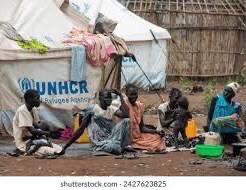
She stayed in Zamzam refugee camp as the violence closed in, tending to the wounded with her medical team.
They died together when the RSF attacked the camp on April 11.
These are not statistics.
These are names.
And names carry stories.
And stories carry truth.
And truth demands we respond.
Sudan is not Gaza. It is not Ukraine. It is not Syria or Afghanistan.
It is its own wound, its own tragedy.
But what binds them all together is the unbearable reality that, once again, innocent men, women, and children are the ones who suffer most.
More than 10 million Sudanese displaced.
Entire communities destroyed.
Women and girls subjected to sexual violence on an industrial scale.
Doctors and nurses targeted.
Aid workers hunted.
Starvation used as a weapon of war.
And in all of this, the world has mostly looked away.
This is not just a civil war.
It is a war on civilians.
A war on humanity.
And it is being waged by two forces—the Sudanese Armed Forces and the Rapid Support Forces—who once stood together and now battle for power, land, and control.
Both speak the language of religion.
Both claim to protect Sudanese identity.
But they have betrayed both.
And what is especially heartbreaking for me, as a Christian observer, is this:
These are Muslims turning on Muslims.
Followers of the Prophet Muhammad—who commanded compassion, justice, and the protection of the innocent—now unleashing fire upon one another.
This is not Islam.
This is not faith.
This is betrayal.
This is the killing instinct that takes hold when power becomes more sacred than people.
We saw it in Rwanda. In Bosnia. In Syria. In Gaza.
And now in Sudan.
It always begins the same way:
With fear.
With division.
With old hatreds reignited.
And then, slowly, ordinary neighbours begin to do extraordinary harm.
Robert F. Kennedy once said that violence:
“is a disease—infecting not just those who commit it, but those who tolerate it.”
Sudan is bleeding, not only because of guns and machetes—but because the world has tolerated the silence.
The UN tries. Aid agencies plead. But the mechanisms of peace are moving too slowly,
and the price is being paid in flesh and fire.
And yet, I still believe in the Sudanese people.
I read the story of a midwife who, with no electricity, no medicine, and no security, continues to deliver babies by candlelight.
I read of mothers shielding their children with their own bodies.
Of young men smuggling food across checkpoints.
Of doctors risking death just to tend the wounded in hiding.
That is the Sudan the world needs to see.
Not just the wreckage, but the resilience.
Because what is happening is not just a crisis—it is a test.
A test of our compassion.
A test of our priorities.
A test of whether we will only speak when it is popular, or when it is right.
We need to act.
Not tomorrow.
Now.
We need humanitarian corridors.
We need global diplomacy that puts pressure on all sides.
We need accountability for war crimes.
We need aid that is protected, not pillaged.
And we need moral clarity—the kind that rises above politics and speaks plainly:
This must stop.
Not for geopolitical advantage.
Not for headlines.
But because every child buried in Sudan is a failure of human conscience.
As a Christian physician living in Australia, I make no claim to political expertise.
But I know the Hippocratic Oath. I know the teachings of Jesus.
And I know that when suffering like this is met with silence, it becomes complicity.
Sudan deserves more than our pity.
It deserves our action.
So let this be a call—to people of all faiths, and no faith:
Let us not stand idly by.
Let us not wait for another massacre before we speak.
Let us honour the living—and remember the dead—not just with prayers,
but with pressure, purpose, and presence.
If there is any justice in the world, Sudan will not remain a forgotten war.
And if there is any courage left in our collective conscience, we will ensure that it does not end in silence.
But in this world, modern pharaohs have risen again—
not in ancient robes, but in new uniforms,
not in pyramids, but in palaces and bunkers,
not with staffs, but with drones and bayonets.
Let my people go.
A new generation of Gestapo has emerged since Auschwitz.
They do not wear swastikas, but they leave the same stench of death:
Terror.
Indiscriminate slaughter.
The execution of children.
The starvation of innocents.
The systematic breaking of the human spirit.
If Easter Monday is a promise of life,
then war crimes—however and wherever they are committed—
are a curse upon those who commit them.
And they are a promise to today’s pharaohs,
wherever they may dwell:
That thunder will follow them.
That lightning will find them.
That the cry of the oppressed will not be silenced—by guns, by graves, or by the world’s forgetting.
Let my people go.
>>>
Disclaimer: This article is a personal humanitarian reflection, written in my capacity as a concerned global citizen and family physician. It is not a political statement, nor is it intended to represent any institution or organisation. The views expressed are rooted in moral conviction and a commitment to the preservation of human life.
—Paul Alexander Wolf
 We dream of things that never were and say: "Why not?"