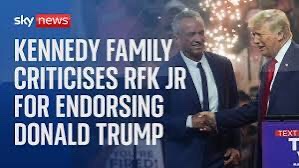
From Camelot to Conspiracy: The Kennedy Legacy’s Unlikely Turn
The Kennedy family, often regarded as America’s political royalty, has long been associated with public service, idealism, and a commitment to progressive change. From JFK’s visionary leadership to RFK Sr.’s fierce advocacy for civil rights, the family name once symbolized a higher standard of public duty. But in the case of Robert F. Kennedy Jr., the family’s legacy seems to have taken a strange and unexpected detour—one that leads not to Camelot, but to conspiracy theories, vaccine skepticism, and a puzzling alliance with some of the very forces his forebears opposed.
In his heyday, John F. Kennedy was a master of political strategy and collaboration. He surrounded himself with a diverse team of advisors, carefully weighing expert opinions before making decisions. Whether navigating the Cuban Missile Crisis or laying the groundwork for civil rights legislation, JFK understood the value of informed leadership. Listening, learning, and then acting—this was the Kennedy way.
Fast forward to today, and a different approach is on display from JFK’s nephew, Robert F. Kennedy Jr. While RFK Jr. carries the family name and political pedigree, his public statements and actions have diverged sharply from the legacy of evidence-based leadership his uncle and father embodied. His controversial stances on public health—particularly his skepticism toward vaccines—have placed him in stark opposition to the scientific consensus, leaving many to wonder: What would JFK think?
In the United States, Europe, and Australia, public health initiatives have long relied on rigorous scientific research to protect communities. The rejection of such principles—whether in the context of the COVID-19 pandemic, the resurgence of measles, or broader vaccine misinformation—feels alarmingly out of step with the Kennedy tradition. This shift has led to an uneasy question: How did a name once synonymous with progress become entangled in movements that undermine it?
The Evolution of RFK Jr.: From Environmental Crusader to Conspiracy Theorist
Robert F. Kennedy Jr., the son of Senator Robert F. Kennedy and nephew of President John F. Kennedy, was once a respected environmental lawyer. His work with the Waterkeeper Alliance and his efforts to hold polluters accountable earned him a reputation as a tenacious advocate for public health—at least in the environmental realm. But over time, his focus shifted. What began as a crusade against corporate greed morphed into something far more controversial: an aggressive skepticism of vaccines and mainstream medicine.
While RFK Sr. fought for civil rights and government accountability, his son has taken the Kennedy name in an entirely different direction. His anti-vaccine rhetoric, which critics argue spreads misinformation, has created a deep rift between him and the medical community. Even more jarring was his brief alignment with the Trump Administration as a potential “vaccine safety” advisor—an ironic twist, given his family’s historic opposition to figures who downplay expertise and evidence-based policy.
What Would RFK Sr. Think?
If the late Senator Robert F. Kennedy could weigh in today, one could imagine him offering his son a stern lecture on responsibility, leadership, and the duty to seek the truth. This was a man who stood up to injustice, challenged entrenched power structures, and fought tirelessly for those without a voice. The idea that his own son would undermine public health efforts—efforts designed to protect the most vulnerable—feels like a profound break from his legacy.
For those who remember RFK Sr.’s impassioned speeches and fearless advocacy, the notion of dismissing expert advice in favor of personal convictions would seem foreign, if not outright dangerous. After all, this was a leader who listened carefully, understood the weight of his words, and acted with conviction. One can almost picture him now, in some alternate reality, calling a family meeting at Hickory Hill and reminding his son that public service is not just about having a famous last name—it’s about using that name responsibly.
The Kennedy Legacy at a Crossroads
As the world grapples with new public health challenges, the Kennedy name remains powerful—but its meaning is shifting. The era of JFK and RFK Sr. was defined by hope, progress, and an unwavering belief in expertise. The era of RFK Jr. is marked by something else entirely: a wariness of institutions, a reliance on alternative narratives, and a troubling departure from the very principles that once defined his family.
At a time when misinformation spreads faster than truth, the Kennedy legacy faces a choice. Will it remain a symbol of rational, courageous leadership? Or will it become entangled in the very forces it once fought against?
One thing is certain: if JFK and RFK Sr. were alive today, they would have some serious words for the current iteration of their family’s influence. And it’s safe to say those words wouldn’t be particularly kind.
Paul Alexander Wolf
 We dream of things that never were and say: "Why not?"